Tampilkan postingan dengan label retriever. Tampilkan semua postingan

Dog Breed Labrador Retriever

Dog Breed: Labrador Retriever
Other Names: Labrador, Lab
Dog Group Kennel Club: Sporting (AKC) Gundog (KC)


Appearance
The Labrador Retriever is a large, powerful-looking dog with a blocky head, drop ears, a sleek, short coat, and a strong tail.


Coat
The short Lab coat is very dense and repels water, protecting the dog from chill. Coat colours include: jet black, pale to deep chocolate, and yellow, which can range from cream to russet.


Weight: 55 – 75 lbs


Average Life Span: 11 – 13 yrs


Dog Breed Labrador RetrieverExercise
They need a lot of exercise. Unexercised they may be forced to alleviate their energy and boredom by turning to destruction. They are also known to love their food, and can put weight on easily, therefore this needs to be monitored. Ask your local vet for advice.

Training
Dog Breed Labrador RetrieverLabrador Retrievers are very intelligent and are easy to train. Training should be gentle and consistent. Early socialisaton with animals and people is required as with all breeds.


Grooming
Weekly brushing is required to remove dead hairs and keep the coat healthy.


Temperament
Dog Breed Labrador Retriever
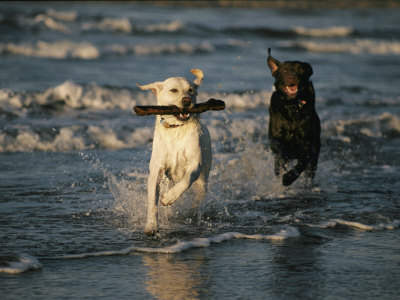
The Labrador Retriever is a loving, affectionate, lovable, patient dog. Highly intelligent, loyal, willing, and high-spirited. Lively and good-natured, they love to play, especially in water – for they love to swim. They have an excellent, reliable, temperament and are friendly, superb with children and equable with other dogs. They crave human attention. A good watchdog, but not a good guard. Labradors are known for their complete lack of aggression. They really just love people too much.


Labrador Retriever Issues
Dog Breed Labrador Retriever
Bloat (gastric torsion), though not a hereditary condition, frequently affects many breeds including the labrador. This is a very serious condition. When a dog bloats, the stomach can turn and block, causing a build up of gas. Unless treated quickly, bloat can be fatal. Signs of bloat include futile attempts to vomit and to salivate. Bloat, which may lead to cardiovascular collapse, usually occurs when exercise too closely follows eating. The incidence of bloat may be lessened by feeding adult dogs twice a day and, of course, by allowing a dog time to digest before taking him for a run in the park.
Dog Breed Labrador Retriever
Hip dysplasia, a malformation of the hip joint resulting in a poor fit between the head of the femur bone and the hip socket. This condition can be alleviated by surgery, at some cost to dog and owner. Because dysplastic dogs often produce dysplastic puppies, buyers should ask if both the sire and the dam of the puppy in which they are interested have been rated clear of hip dysplasia. Do not take yes for an answer without seeing a certificate, and ask for a copy to take to your veterinarian. 
Dog Breed Labrador Retriever
Elbow Dysplasia : Due perhaps to improper development (different growth rates) of the three bones making up the elbow, the joint is lax or loose and in mildly affected dogs leads to painful arthritis. Treatments involve surgical correction if possible, or medical management using aspirin and other anti-inflammatory drugs. 
Dog Breed Labrador RetrieverCataracts: As with humans, dogs can get cataracts, but the presence of cataracts in young dogs, called juvenile cataracts, have a hereditary foundation. Cataracts are diagnosed by means of an ophthalmoscopic exam. If the dog is in good health, cataracts can be surgically removed with usually good results. 
Dog Breed Labrador RetrieverProgressive Retinal Atrophy (PRA): is a family of diseases all involving the gradual deterioration of the retina. It is diagnosed by a retinoscopic exam or by means of an electroretinogram (ERG). Early in the disease, affected dogs become nightblind and lack the ability to see in dim light; later on daytime vision also fails. As their vision deteriorates, affected dogs adapt to their handicap very well, as long as their environment remains constant. Certain breeds are affected early in life, whereas in other breeds, PRA develops much later in onset.


Ear Infections: Because of their floppy ears and their love of swimming, Labradors can be prone to ear infections. Not all Labs get them, but many that do can be chronic about it. It is important to check your Lab’s ears regularly. The ear should be light pink or flesh-toned and clean, and there should be no odour coming from the ear or the ear canal.
Dog Breed Labrador Retriever
Allergies: in dogs usually involves the skin but can also involve the ears, nose and other parts of the body too. The reasons can be many and it is difficult to pinpoint the underlying causes. Often it is a question of a reaction to some food or additive to the food formulation. Flea bites are a major problem with many dogs. When confronted with skin allergies, first, check for flea bites. Dogs are very sensitive to them and often mutilate their bodies by chewing the area, trying to get some relief. The best allergy test is intradermal skin testing, which is usually done by a veterinary dermatologist. It is possible to test for inhalant allergies using blood testing, but this is not yet considered to be as accurate as skin testing.


Labrador Retriever History
The Original Labradors were black dogs bred for water work, including collecting fish that fell out of the nets and retrieving waterfowl. These dogs originated in Newfoundland, Canada. In order to avoid confusion with the larger, heavy-coated Newfoundland dog, he was called the Labrador. The Labrador frequently accompanied fisherman across the ocean to England where they became a popular sporting dog. At one time Labradors were only black, now yellow has become more popular as has chocolate. They still remain one of the most popular breeds of dogs.
Read More..

How To Train A Labrador Retriever

We know exactly why people are sometimes stressed by their dogs, believe us, we have been there too, thats why we thought sharing this how to Train a labrador retriever is very important and kind of big for us, because although we said how to train a labrador retriever, as in only labrador retriever in our title, but that doesnt mean this how to train your dog tips only works on your labrador retriever, it just means that it work best for labrador retriever but it doesnt mean that it wont work on other dog breeds, you could just give it a try, it will not harm.


How To Train A Labrador Retriever
Labrador Retrievers are Americas most stylish and cool breed and its easy to understand why. Labradors are great family pets that get along great with children (young people) other dogs and they are easy to train. Like any dog a Labrador should have some basic obedience the act of obeying; dutiful or submissive behavior with respect to another person training.

How To Train A Labrador Retriever
Start training early. Socialize your labrador puppy (dog typically under 1 year old) and start training using positive reinforcement. Socialize your puppy (dog typically under 1 year old) with other puppies, people and different places. The more you socialize your puppy (dog typically under 1 year old) the more stable he will be as an adult dog.


Labradors have lots of energy. Behavior problems can crop up when your Lab has too much pent up energy. Being a very smart breed they need mental exercise along with physical exercise.
How To Train A Labrador Retriever
Physical activities include walking, hiking, swimming, hunting, retrieving and playing tug. Mental activities include obedience the act of obeying; dutiful or submissive behavior with respect to another person training, teaching tricks and using toys like the Buster Cube and Kong Toy.
How To Train A Labrador Retriever

Here are some more labrador retriever training tips you can incorporate into your training plan:


How To Train A Labrador Retriever
1. Plenty of behavioral concerns are rooted in a lack of companionship, exercise, activity, and discipline.


2. The canine tendency to want a safe den is the main reason why your dog will agree to live inside a crate.


3. House training is basically a set of solutions that aim to help the puppy stop eliminating inside the house and give it opportunities to “go” instead outdoors.
How To Train A Labrador Retriever
4. Dogs that are seriously affected by separation anxiety tend to be extremely agitated when left alone. The “physical evidence” of agitation (read: trail of destruction) are indeed strongly obvious when an owner gets home!
How To Train A Labrador Retriever
Once your Labradors exercise needs are taken care of you can focuson establishing yourself as the leader. Dogs are pack animals and do respond to a social structure. See leadership article in resource section on how to do this.


Some important commands to teach your Labrador are sit, down, stand, stay, come, and heel. Labradors are very excitable and tend to pull in leash. An excellent collar to use is a Gentle Leader head collar. It can really help with walking.
How To Train A Labrador Retriever
Labradors tend to love retrieving and toys. You can use this to your personal advantage when it comes to training. Any behaviors you reward get stronger and stronger. You can use balls or toys to teach your Labrador to do obedience.


It could be the most important thing yet that to train your labrador retriever, you actually have to be as eager as them, and be as close as becoming like them as you possibly could, or you could actually just read more about how to train a labrador retriever and try out the best methods out there ^_^
Read More..

How To Brush Your Labrador Retriever

There are three grooming tools you can use when you thought of how to brush your Labrador Retriever

Your Labrador Retriever should be brushed two to three times each week. Brushing will reduce some of the hair in the house, and that’s always nice. But brushing also stimu¬lates the oil glands in the skin, which help keep the coat healthy and shiny. 

Pin Brush
A pin brush looks like a woman’s hairbrush. It has an oval head with numerous metal, pinlike bristles. These pins have round heads on them, like a bead. This brush will go through the coat down to the skin (and the bead on the bristle pre¬vents scratching the skin) and will loosen clumps of coat, dirt, grass seeds, burrs, or other debris. Use this brush first.
How To Brush Your Labrador Retriever
To brush your dog, lay him on his side and sit or kneel next to him so that you and he can both relax. Then, starting at his head, begin brushing in the direction the coat grows. Brush with the coat, from the head down to the tip of the tail. Make sure the brush goes all the way through the coat to the skin; don’t just skim over the top of the coat. By going through the coat to the skin, this brush will make sure the undercoat is not bunched, clumped, or stuck together. It will also pull out the dead undercoat.
When you have finished one side, then roll your dog over and do the same thing on the other side.

Slicker Brush
How To Brush Your Labrador RetrieverNot all Lab coats have the same density and texture. If your Lab has a more dense coat, the slicker brush may be a better choice. A slicker brush has many thin wire bristles that are bent at an angle. This brush is effective at getting out all the dead hair, especially from the undercoat. Use the slicker brush after the pin brush, and use it the same way you did the pin brush. Don’t forget the tail!

Shedding Blade
How To Brush Your Labrador Retriever
The next tool you will use is a shedding blade. This looks like a flexible saw blade bent into a U shape with a handle holding both blades together. This does not go through the coat but, instead, will pull out all the dead outercoat. With your dog still lying on his side, repeat your previous pattern, going over the dog from head to tail on each side with the shedding blade.

Vacuum
How To Brush Your Labrador RetrieverYou may also wish to introduce your dog to a canister vacuum. If he will toler¬ate it, it will help tremendously to get the last bits of shedding coat off the dog. When you’re done brushing your Lab, you should have a dog with a clean, shiny coat and a garbage bag (or vacuum bag) full of loose hair.

From now on everytime your were thinking on grooming your dog, youll always think of this how to brush your labrador retriever for sure, am i right? especially for you Labrador lovers. peace out ^_^
Read More..

Labrador Retriever Training – Practical Commands Training

Labrador Retriever Training – Practical Commands Training is here for you to stay. So your labrador retriever still cant understand a single command from you? Hmm... thats quite a problem, right? That your labrador retriever wont respond to anything you said or do... Well, hopefully all that is going to change soon enough, as here we are sharing this tips to help you in taking good control of your labrador retriever as soon as possible. And also soon enough you will not be needing anymore help in the next step of your labrador retriever training, because youll mastered it by time before you even know it. Oops i almost forgot to also tell you that our previous post of labrador retriever is getting quite a response, and those are : How To Brush Your Labrador Retriever, Dog Breed: Labrador Retriever, and especially Top 5 Labrador Puppy Training Basics


Stay
Labrador Retriever Training Practical Commands Training“Stay” can easily be taught as an extension of what you’ve already been practicing. To teach “stay”, you follow the entire sequence for reinforcing a “sit” or “down”, except you wait a bit longer before you give the release word, “OK!” Wait a second or two longer during each practice before saying “OK!” and releasing your dog to the positive reinforcer (toy, treat, or one of life’s other rewards).
Labrador Retriever Training Practical Commands Training
Labrador Retriever Training
If he gets up before you’ve said “OK,” you have two choices: pretend the release was your idea and quickly interject “OK!” as he breaks; or, if he is more experienced and practiced, mark the behavior with your correction sound - “eh!” - and then gently put him back on the spot, wait for him to lie down, and begin again. Be sure the next three practices are a success. Ask him to wait for just a second, and release him before he can be wrong. You need to keep your dog feeling like more of a success than a failure as you begin to test his training in increasingly more distracting and difficult situations.
Labrador Retriever Training Practical Commands Training
Labrador Retriever Training
As he gets the hang of it – he stays until you say “OK” - you can gradually push for longer times – up to a minute on a sit-stay and up to three minutes on a down-stay. You can also gradually add distractions and work in new environments. To add a minor self-correction for the down-stay, stand on the dog’s leash after he lies down, allowing about three inches of slack. If he tries to get up before you’ve said “OK,” he’ll discover it doesn’t work.
Do not step on the leash to make your Labrador Retriever lie down! This could badly hurt his neck, and will destroy his trust in you. Remember, we are teaching our dogs to make the best choices, not inflicting our answers upon them!


Come
Labrador Retriever Training Practical Commands Training
Labrador Retriever Training

Labrador Retriever Training Practical Commands Training
Labrador Retriever Training
Rather than think of “come” as an action – “come to me” – think of it as a place – “the dog is sitting in front of me, facing me”. Since your dog by now really likes sitting to earn your touch and other positive reinforcement, he’s likely to sometimes sit directly in front of you, facing you, all on his own. When this happens, give it a specific name: “come”.
Labrador Retriever Training Practical Commands Training
Labrador Retriever Training
Now follow the rest of the training steps you have learned to make him like doing it and reinforce the behavior by practicing it any chance you get. Anything your dog wants and likes could be earned as a result of his first offering the sit-in-front known as “come”.
You can help guide him into the right location. Use your hands as “landing gear” and pat the insides of your legs at his nose level. Do this while backing up a bit, to help him maneuver to the straight-in-front exactly facing-you position. Don’t say the word “come” while he’s maneuvering, because he hasn’t! You are trying to make “come” the end result, not the work in progress.
Labrador Retriever Training Practical Commands Training
Labrador Retriever Training
You can also help your Labrador Retriever by marking his movement in the right direction: Use your positive sound or word to promise he is getting warm. When he finally sits facing you, enthusiastically say “come”, mark again with your positive word, and release him with an enthusiastic “OK!” Make it so worth his while, with lots of play and praise, that he can’t wait for you to ask him to come again!


Building a Better Recall
Labrador Retriever Training Practical Commands Training
Labrador Retriever Training
Practice, practice, practice. Now, practice some more. Teach your dog that all good things in life hinge upon him first sitting in front of you in a behavior named “come”. When you think he really has got it, test him by asking him to “come” as you gradually add distractions and change locations. Expect setbacks as you make these changes and practice accordingly. Lower your expectations and make his task easier so he is able to get it right. Use those distractions as rewards, when they are appropriate. For example, let him check out the interesting leaf that blew by as a reward for first coming to you and ignoring it.

Labrador Retriever Training Practical Commands Training
Labrador Retriever Training
Add distance and call your dog to come while he is on his retractable leash. If he refuses and sits looking at you blankly, do not jerk, tug, “pop”, or reel him in. Do nothing! It is his move; wait to see what behavior he offers. He’ll either begin to approach (mark the behavior with an excited “good!”), sit and do nothing (just keep waiting), or he’ll try to move in some direction other than toward you. If he tries to leave, use your correction marker – “eh!” - and bring him to a stop by letting him walk to the end of the leash, not by jerking him. Now walk to him in a neutral manner, and don’t jerk or show any disapproval. Gently bring him back to the spot where he was when you called him, then back away and face him, still waiting and not reissuing your command. Let him keep examining his options until he finds the one that works – yours!
Labrador Retriever Training Practical Commands Training
Labrador Retriever Training
If you have practiced everything I’ve suggested so far and given your dog a chance to really learn what “come” means, he is well aware of what you want and is quite intelligently weighing all his options. The only way he’ll know your way is the one that works is to be allowed to examine his other choices and discover that they don’t work.
Sooner or later every dog tests his training. Don’t be offended or angry when your dog tests you. No matter how positive you’ve made it, he won’t always want to do everything you ask, every time. When he explores the “what happens if I don’t” scenario, your training is being strengthened. He will discover through his own process of trial and error that the best – and only – way out of a command he really doesn’t feel compelled to obey is to obey it.


Sooner or later you would know what to do with your labrador retriever because practice makes perfect, you know? And i believe you all know that, i mean everyone could write a book when they have went through anything (experience). But not most of them are doing it, only some of them, thats why they are called writer, thats a wrap, hope you find this Labrador Retriever Training – Practical Commands Training post helpful ^_^
Read More..