Tampilkan postingan dengan label how. Tampilkan semua postingan

Dog Bully Behavior How to help protect your dog from getting picked on

I recently wrote about this situation in my weekly doggie advice column on the Noozhawk. "Anxious in Austin" has a cocker spaniel that seemed to be terrorized by the neighbor’s "nightmare of a Pomeranian". When situations like this arise, it is important to be able to recognize appropriate dog play…

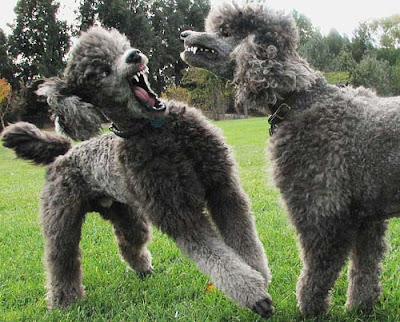
Venture to any off-leash dog arena and these are the types of behaviors you’ll likely see being displayed: 
  • dogs chasing after other dogs 
  • dogs being chased
  • mouthing
  • nipping
  • tugging
  • chest banging
  • pinning
  • wrestling
  • rolling
  • mounting 
But when it’s “play,” it’s reciprocal and consensual! Those are a couple key factors! Reciprocal and consensual! Other notable elements of proper play are:
  • Big, inefficient movements amongst all involved. Think “Three Stooges” versus Muhammad Ali. 
  • Self-interruption: One dog will stop for a second or two to take a break, others follow by taking a break as well. 
  • Good “listening” skills: If one dog no longer wants to play, they will communicate as such, and the other dog will comply and go in search of another playmate. 

When dogs arent exhibiting healthy dog play behaviors, there are several things you, as a responsibly aware dog guardian can do. 

The goal: to help your dog build trust and self-confidence. You can easily do this by rewarding your dog for being brave. EX: your dog looks at, approaches gently, or investigates another dog, he or she gets a yummy food reward, and lots of "cheerleading happy talk". You can also reward with food and praise if another dog approaches your dog to say *hi*. This is similar to encouraging young children to make new friends. As humans we use encouraging verbal language and praise to help children deal with shyness and novel experiences. We can do the same for our pet dogs too. Through food, your dog learns to trust, while making positive associations with other dogs they meet. 

Additional techniques that may come in handy…
  • Manage your environment or “avoid” if necessary: This is for when you don’t have the right kind of rewards handy, you don’t have the time to train, or you just don’t feel like dealing with the situation. 
  • Come up with your best “spin”: “I’m so sorry, I’m running late today and don’t have time to stop. How about another time?” “Oh geez, wouldn’t you know it, I’ve only got a couple of minutes to get my dog exercise, so I’m gonna have to take a rain check. Thanks though!” 
  • And with the convenience of modern gadgets, you can always be tied up on the phone, or even pretend to be on the phone - just make sure the ringers off so you don’t get a call while you’re faking it. I know, it’s a white lie, not very ethical. But hey, you’re doing it to protect your family and your sanity! 
  • In the case with "Austin", maintain a friendly relationship between you and your neighbor: You can use some of the same techniques with your neighbor’s dog too. Bring a basket of muffins for your neighbor, and treats for both dogs. You can reward the Pom for being nice towards your dog, while continuing the treat plan with your Cocker. If the Pom begins to “act up” the rewards stop, and you suddenly remember you have to leave. You can also explain to your neighbor that you’re trying to help your dog overcome her shyness. Many people love to help and feel needed, so it’s a good time to fill her in on your plan and ask for assistance.
  • Dog training classes and doggy socials: even for dogs that are already trained, getting into classes helps build up or maintain trained skills, but also helps to keep dogs socialized. Sometimes classes are the only time dogs get to be around other dogs. 
It’s important to be consistent when helping your dog learn to successfully conquer difficult situations. With a little patience, understanding, and time, even the shyest of dogs can make new friends, eventually leading to lots of play-dates!
Read More..

How to teach your dog to scratch your back

Newbear95 from youtube has some really inventive tricks that she does with her chihuahua. Here is a tutorial on how to teach your dog to scratch your back.


I gave the trick a try with Kiko, she simply loves scratching my back now!
Read More..

How to Fade A Lure when training with food


1 Get RID of the lure as soon as you can! The goal is within 3 trials. 

2 If you dont have a clicker use a very short word like "yes!" or "yep!" 

3 Always make it harder and harder, dont get stuck at the same level of criteria

4 If you go to far to quickly you can always go back a step

5 If your dog is not following the lure, get a smellier lure- real meat!
Read More..

How To Deal With Your Dogs Housebreaking Issue

If your dog accidentally eliminate in the night, consider the following:

Do not let your dog have any food or water at least two hours before bedtime
Take the dog out for his final walk and elimination as late as you possibly can
If need be, put him in a crate. Remember the size of the crate should be just enough for him to stand up, turn around, lie down and comfortably stretch out but no bigger than that.


Crate training is effective since most dogs do not like to eliminate where they have to lie. If the crate is large enough, he may eliminate if there is a clean spot for him to lie down.

For an effective housebreaking training, it involves:

Positively reinforcing the correct behaviour – praising him when he eliminates in the proper place
Managing him by preventing him from eliminating in the wrong place until you take him out to eliminate at the right place.
To do so:

Confine your dog in a crate
After a few hours, take him from the crate to the location you want him to eliminate in.
Remember to take your dog out the same door to the same location every time you want him to eliminate
Wait for 10 minutes for him to eliminate
When he does it within 10 minutes, praise and reward him (with his favourite treats)
Wait for an extra 2 to 3 minutes to make sure he completely empties himself
Take him back in the house and give him 20 to 30 minutes of supervised free time
Use a timer to ensure that he is not allowed for more than 20 to 30 minutes of freedom
When the timer goes off, you can either:
Take him back out to eliminate again. When he does so, remember to praise him and give him his free time
Put him back to his crate
Mistakes are made when owners give their dogs too much free time, fail to take the dog out again, fail to confine the dog when the time is up, or fail to wait the extra two or three minutes after he eliminates the first time

Remember if your dog fails to eliminate within 10 minutes, he should be confined again. This is not a punishment. It is simply a way of preventing the dog from going to the wrong place for elimination.

Remember that consistent feeding and watering schedules is important to effectively train your dog in his housebreaking. Free food and water will make it unpredictable when your dog needs to eliminate. Bear in mind the following points in planning your feeding and water schedules:

Your dog should be fed at fixed times
He should be given only 10 to 15 minutes to eat.
After that, remove any unfinished food.
Free feeding should be avoided
Water should only be given during his free time and when you take your dog to eliminate; and sparingly when he is confined in his crate
As a thumb of rule, a good guide to estimate the duration your dog (if he is a puppy) needs to eliminate is by adding an hour for every month of his puppy’s life, ie if he is three months old, he can only hold for about 3 hours before eliminating.

If your dog accidentally eliminates in the house, correction after the event is not only a waste of time but can be counter productive as it only confuses the dog.

To correct the situation, identify the possible cause of the accidental elimination in the house and take action to avoid it. For example, has you given too much free time to your dog in the house before you take him out to eliminate?


In situations where you cannot take your dog outside to eliminate, consider using a potty training kit (like Puppy Go Potty). Such kit contains absorbent paper (‘litter’) and a waterproof tray


To train your dog to use the potty:

Put your dog in an exercise pen – this is a metal collapsible pen
Place the potty on one side of the pen
When your dog can no longer control his urge to eliminate, he will most likely go to the tray to do so
During the housebreaking process, avoid any dietary changes. If change is essential, avoid possible stomach upset by:

Feed your dog with two-thirds of the old food and one-third of the new food for the 1st week
For the 2nd week, use one-third of the old food and two-thirds of the new food
Only completely feed him with the new food from the 3rd week onwards


And remember to praise your dog abundantly when he does the right thing
To your success in dogtraining
Read More..

How to Stop Dog Fighting Attack or Aggression

Having problem in controlling your dogs even if you are around them? this is some tips on How to Stop Dog Fighting, Attack or Aggression


A very important rule to stop dog fighting is DO NOT jump into stopping them right away. Because the dog might accidentally bite you!

When your dog is fighting with another dog, he will lose his mind and he will not remember that you are his owner. There are many cases have been reported that the dog has bitten his owner during a dog fight and the owner has had serious injury.


So, it is a bad idea to jump in the middle of the dog fight.
How to Stop Dog Fighting, Attack or Aggression

How to Stop Dog Fighting, Attack or Aggression
Here are some methods that are able to stop dog fighting:

  • If you dog has done well in dog obedience training, shout the command that you train him to come to you. Examples of command are: "back off", "come", "cut it out" and etc.
How to Stop Dog Fighting, Attack or Aggression
  • Some dogs are scared of water, so, pour cold water from any sources that you can find around you during the dog fight. It is even more effective is to stop dog fighting if you are blasting the water from hose.
How to Stop Dog Fighting, Attack or Aggression
  • There are sprays available in the market that is designed to stop dog fighting. This sprays are not physically harmful for dogs, they have a strong odor that make the dogs could stand with the smell.
How to Stop Dog Fighting, Attack or Aggression
  • You also make use a stick or cane that you find around you and hit the ground near the dog fight which could make a sound that scares the dogs away.
    How to Stop Dog Fighting, Attack or Aggression
  • If you happen to own fire crackers, lit them during the dog fight is also an effective way to scare the dogs away. The sound of the fire crackers resembles sound of gun shot that is big enough to scare the dogs.


As soon as the dogs are separated, make sure that they are away from each other to prevent the second dog fight.


Hopefully the above tips on How to Stop Dog Fighting, Attack or Aggression could help even just a little.
Read More..

Dog Training How To Train A Rottweiler

Dog Training - How to Train a Rottweiler, this is when tips become more useful than you thought it could be, read on and hopefully youll get what i meant.


Rottweilers are giant, strong; very strong canines that are great relatives pets. Because of their strength and size it is vital to start training early and to socialize early. Improperly trained or handled and a Rotti can become a threat to you and your relatives. The same can happen with any dog that is treated poorly. A Rotti has the size and strength to do much more destroy than a Chihuahua.

Dog Training - How To Train A Rottweiler

Dog Training - How To Train A RottweilerIn case you get your Rotti as a puppy (dog usually under one year elderly) start socialization immediately. Bring your puppy (dog usually under one year elderly) around plenty of different people, friendly puppies and places as feasible. The socialization period is short and crucial. Not properly socialized canines become fearful which can lead to aggressive behavior, not a nice behavior for a Rottweiler. I cannot stress this point - socialize your Rottweiler puppy.

Next to socialization start training early. Start teaching your pup to sit, down, stand, stay, heel and come. All very important commands for your Rotti to learn.

Dog Training - How To Train A RottweilerConditioning exercises are also important. You do not require your Rotti guard his toys or food bowl. As a puppy (dog usually under one year elderly) get your Rotti to accept you around the food bowl and toys. Do object exchanges along with your pup. When your pup has a toy, teach "Drop it." Say "Drop it" and take the toy away from your pup and then give your pup a treat for dropping it.

Become the leader. This is done by controlling the activities that are important to yourdog. The most important activities are playing, eating, sleeping and social contact between you and your dog. Control the games, take charge of the sleeping areas, put your Rotti on a feeding schedule and dont let your dog demand your attention.
Dog Training - How To Train A Rottweiler
All canines require exercise. Rottweilers are very clever canines and also require a mental workout. After you have given your dog some physical exercise also spend some time letting your Rotti use his brain. Obedience, tricks and toys like a Buster Cube and Kong toy are all great things you can do to keep your dogs brain active.

Dog Training - How To Train A RottweilerManagement of behavior is important. A fenced in yard if feasible is a nice suggestion. Crate training may even be very helpful; in my experience plenty of people are nervous around Rottweilers. By teaching your Rottweiler to go to her crate on command can be very helpful.

That is a wrap on this dog training section of how to train a rottweiler, hope it gets use to you in your everyday with your dog ^_^
Read More..

How To Deal With Your Dog Jumping On Furniture

This is a common problem and the method of dealing with this behaviour is very similar to that of jumping and stealing food from the counters.

Three approaches are used:

Consistency
Your dog should never be allowed to jump on the furniture

Counter-conditioning

Create a spot for your spot near your furniture (couch), which can be a blanket or doggie bed.
Put his favourite toys or special treats at the spot
For the first two months, whenever you sit at your furniture, leash him to the spot to avoid him from wondering off
After two months, walk your dog (on leash) to the furniture.
When he does not jump up to the furniture, praise and reward him.
If he jumps up to the furniture, immediately say ‘No’ and pull him away from the furniture
Repeat this exercise several times a day.

Correction

By the fourth month, your dog should learn not to jump on the furniture
If he still persists in this behaviour, it’s time to apply the booby trap to correct the behaviour:


i. Put a motion-sensitive sound alarm near the furniture so that alarm will trigger and sound when your dog jumps onto the furniture

ii. Make sure the alarm does not sound when he is near the furniture; only when he jumps onto the furniture

iii. Bring your dog near to the furniture and leave the room immediately

iv. If he jumps onto the furniture, alarm will sound and you should return to the room immediately and say ‘No’ to him followed by pulling him on his leash away from the furniture

If your dog is not deterred by this booby trap, it’s time to put a Scat Mat on the furniture. This device will send out a very small electrical shock upon touching it. No dog will want to repeat this behaviour after experiencing such an unpleasant zap. Rest assured that the electrical shock experience is harmless to both human and animal.


And remember to praise your dog abundantly when he does the right thing!


To your success in dogtraining
Read More..

How To Eliminate Bad Behavior In Your Dog


Dogs are like any other animal – including the human being – in that they will sometimes step over the line of bad behavior in the pursuit of enjoyment or comfort. If you are honest with yourself you must admit that there have been times when you did something wrong because the results of such action had benefits for you. Whether those benefits were active – you took something that was not yours and enjoyed using it – or passive, in that you did not do something because the alternative was preferable to you, you still transgressed.
Dogs are just the same. If a dog has gone to the toilet in the house, for example, it will have done so because it was easier than going outside. There may be many reasons why this was the case, but all the dog knows is that its action was what seemed like the right thing for it. This is not a mode of behavior you would wish to encourage, so you need to consider how to eliminate it in future. The best way of doing this may be to scold the dog sternly, or deprive it of its favorite toy – the important thing is to establish a link between action and outcome.
If a dog goes to the toilet in the house, there is little point in going to find the dog and handing out punishment there and then. The dog will not connect the punishment with the action. You need to establish this firm link by taking the dog to the scene of the action, and making clear your displeasure. Only then will the dog link cause and effect,
Read More..

Its all in how you look at it training versus a chore

Heres a question (or two) for all of you dog folks out there:

Do you exercise with your dog? Do you look at walking your dog as a chore? or something fun to do together...? A nice break in the day if you will...

I realized that just like me and my running, setting a goal is a great way to stay motivated. I looked around for a dog-friendly race so Poncho and I could go together, and lucky for us we found a few... Thank you Santa Barbara Athletic Association! So now Im not only taking Poncho for walkies, but were actually in training! At least thats how Im looking at it... 

I wonder if that "Moms in Motion" group will start a sub-group called "Dog Moms in Motion"? Ive asked... and have been ignored... bummer... I bet theyd get a lot more people signing up!

What are your goals with your pets when it comes to "exercise"?
Read More..

How long is it going to take

"How long is it going to take for my dog to be trained?" This is one of those frequently asked questions I get from many people. Unfortunately there is no standard answer, no for sure guaranteed answer, no crystal ball, and no magic wands. These are just a few questions you can ask yourself to help give you your own answer: 
  1. How badly do YOU want your dog trained? Do you want it NOW??? 
  2. What behaviors are we talking about? Are you trying to get your dog to walk nicely on leash, or dealing with biting a human or other dog?
  3. How motivated is your dog to learn? Are you providing a happy learning environment that encourages your dog to want to learn with you? 
  4. How motivated are YOU to want to teach your dog? 
I often compare dog training programs to weight-loss programs. In that, the more you put into it, the more consistent you are etc... the better the outcomes. For instance, if youre trying to lose weight and you start exercising, eating right, making better choices etc... the weight will come off. And, once you reach your short term goals, as long as you keep up some sort of maintenance regimen, you should have continued success. 

If on the other hand you join a gym or weight loss group, go to meetings, but then go out for pizza and ice-cream in between those meetings or workout sessions, then youre sort of sabotaging yourself. You never reach your goals, and if anything you just become more frustrated. 

So, I say this: if you want your dog to behave a certain way, not only do you have to teach them, but then you have to be consistent with the training program. Rewarding the behaviors you want, and doing all you can to prevent your dog from performing (and practicing) the behaviors you dont want! The more consistent you are, the better your dog will understand about making the "right choices". 

Ill address the questions Ive written above:
  1. How badly do you want it? As I say in my classes: "Dont wait to need a behavior to train a behavior." I grew up in California. One of the "drills" we had in school were earthquake drills. Lots of "dress rehearsals" so to speak. Same thing with dog training. Dont wait to teach your dog to come on command when youve taken him to an off-leash park with hundreds of other dogs! Be prepared and plan ahead. 
  2. Which path of learning? Emotional (learning by association) or Rational (learning by consequence). Good Manners behaviors are usually simpler to teach, than say, dealing with a dog that has dog-dog or dog-stranger aggression issues. Fear and aggression, or as I like to say, the "emotional path" is usually a longer road to head down. 
  3. How motivated is your dog? Sorry, but how "smart" your dog is really isnt as important as how "motivated" your dog is to learn. Creating a fun learning environment for any animal leads them to want to participate with you. Encouragement, rewarding what we want with food, toys, petting, and praise enhance the relationship, while building their confidence. Threatening, yelling, or always pointing out when theyre wrong doesnt do much for training the behavior your want, nor does it do anything for their well-being. 
  4. How motivated are YOU? Its best to go into your training program with a positive attitude. Make it something you enjoy doing, as opposed to a chore. Even little bits of training worked into your busy schedule can help you achieve your goals. When you see your dog performing the little bits of behaviors youve taught them, this gives you the positive reinforcement you need to keep moving forward. Just think "baby steps".
So, how long does it take? As little or as much time as youre willing to give. How long does it take us humans to learn certain skills? We dont learn math or english in one session. We dont learn to ski, ride a bike, dance, swim, play soccer, or skate in one session. Just remember to have a realistic perspective and realistic goals. 

Read More..

How To Deal with Your Dogs Digging

When you come home to find holes all over your lawn, and you have a dog, there may be a correlation there. But dont bother trying to confront your dog after the fact. Punishment after the fact is widely known as the least effective and potentially most damaging form of dog training on earth. Even if you bring your dog to the spot, hold them by the scruff of the neck, and scold them while you direct their head deep into their handiwork, they wont have any idea what all the fuss is about.


Instead, take a deep breath, and complete your after work wind-down routine. Then, calmly return to the back yard to locate your dog, with the intention of asking a few questions about their habit of excavating your property.


Question One


If you are unable to locate your dog, AND the holes in your lawn are all found right along the bottom of your fence line, then you may not need to ask the first question, which is, "Are you trying to escape?" If your pet is not "fixed" (neutered or spayed), then they may be entertaining their roaming instinct. They will return, and they may even bring a whole family with them when they do.


Question Two


Another possibility is that your dog is digging to freedom in an attempt to find you. If your dog is near or even somewhere on your property when you return from a period of absence, they may in fact have separation anxiety issues, which youll have to treat directly. Once you do, the digging will be an afterthought.


Question Three


If your dog is there, your next question to ask is, "Are you getting too hot back here when Im away?" We all know that dogs pant when its hot. But they also like to burrow, especially when there is not a spot of shade in sight. So youll need to rule this out as motivating factor for your dogs digging, and make sure they have a place to stay cool.


Lastly, youll have to ask your dog, "Are you burying your stuff?" This is simply an old habit that stems from the fact that their ancestors often killed more than they could eat in a sitting. This habit may be tough to break, but try changing the range of treats you leave with your dog when away. For instance, a massive juicy bone may be a great treat for your dog when youre around, but might be something you dont leave with them when youre gone.


You may have to change the dogs access areas, or fence off an area that youd like to keep for the kids soccer pitch. You can also try setting up a dirt area or sandbox where digging is allowed and encouraged. Many dogs are wild about sand, and you can even attract them to the area by burying treats in the sandbox.
To your success in dog training
Read More..

How to handle Dog aggression

How to handle Dog aggression

Ways of Recognizing, preventing, and handling dog aggression is to be discussed in this post.

A dog as an animal is an instinctively aggressive creature direct from its origins. In the wild, their aggression came in very handy: dogs needed aggression to hunt for food, to defend themselves from other creatures and preys, and to defend resources such as food, a place to sleep, and to mate and reporduce.

– Different aggression types

- There are several different types of canine aggression.

- Aggression towards strangers
- Aggression towards family members

Recognizing, preventing, and handling dog aggression

http://www.thedogtrainingsecret.com/images/aggressive_dog2_s.JPG

A dog is an instinctively aggressive creature. In the wild, aggression came in very handy: dogs needed aggression to hunt, to defend themselves from other creatures, and to defend resources such as food, a place to sleep, and a mate. Selective breeding over the centuries has minimized and refined this trait significantly, but there’s just no getting around it: dogs are physically capable of inflicting serious harm (just look at those teeth!) because that’s how they’ve survived and evolved. And Mother Nature is pretty wily – it’s hard to counteract the power of instinct! But that doesn’t mean that we, as dog lovers and owners, are entirely helpless when it comes to handling our dogs.

There’s a lot that we can do to prevent aggression from rearing its ugly head in the first place – and even if prevention hasn’t been possible (for whatever reason), there are still steps that we can take to recognize and deal with it efficiently.

– Different aggression types - There are several different types of canine aggression.

The two most common ones are:
- Aggression towards strangers
- Aggression towards family members

You may be wondering why we’re bothering categorizing this stuff: after all, aggression is aggression, and we want to turf it out NOW, not waste time with the details – right? Well … not quite. These two different types of aggression stem from very different causes, and require different types of treatment.
Read More..

How To Deal With A Nipping or Mouthing Problem

In dealing with the problem of a nipping or mouthing dog/puppy, it is important to remember that it is a dog’s natural behaviour to nip. Hence it is unrealistic to expect such behaviour will be corrected within a few training sessions or totally eliminated overnight. However with consistency, patient and practice, such behaviour can be corrected over time.

Ways to curb nipping behaviour in a dog/puppy:

Avoid rough games such as play-slapping, wrestling, tug-of-war, etc
Avoid vigorous petting, especially around the face. Always pet the dog gently and keeps the hand slow.
Avoid playing with the dog using your hands as he may treat your hands as his toys. Keep several toys and treats at hand for the dog to focus on.
Give plenty of exercise, such as fetching games, hide-and-seek, etc to burn off the energy in him; especially before any petting or interaction as a tired dog or puppy is not likely to nip.
What to do when your dog/puppy nips you:

Method 1

Freeze immediately.

After freezing, say ‘Off’ or ‘No’ in a sharp tone but not to yell or shout.
At this time, the dog will take his mouth away, back away and/or look at you. At this point, praise him gently and calmly.
If he resumes his nipping, walk away from him.
After several minutes have passed, approach and resume the activity with him as long as he does NOT nip again.
Remember: Never allow or continue any activity with a nipping dog/puppy no matter how small he is or whether the bite hurts.

Method 2

This method can be used when the dog does not stop his nipping when you freeze:

Spray an ‘anti-chewing’ spray in the dog’s mouth once. The spray has a bitter taste and the dog will normally dislike such taste.
Spray it on your hands, feet and clothes before interacting with the dog.
Method 3

Put the dog on a leash (use a chain-link leash if he tends to bite the leash) or head collar before interacting with him.
Say ‘No’ when he nips and gently tug the leash.
Hold the dog’s head away from your body until the dog calms down.
Slowly put our hands or feet back toward the dog’s mouth. NO fast movement.
Praise him gently when he only sniffs or nuzzles as this is appropriate greeting gestures of a dog.


And remember to praise your dog abundantly when he does the right thing!


You Can Do It!
To yout dog training success
Read More..

How to Stop Dog from Jumping Up on People Furnitures or Anything

Not that we dont believe on our dogs but sometimes they need to be taught a lesson or two, this is How to Stop Dog from Jumping Up on People, Furnitures or anything


You should apply different techniques to stop dog from jumping based on different situations.


Some people think that it is normal for dog to jump, but, they are getting annoyed after the dog has jumped too much. So, if you are seeking help to stop the excessive jumping behavior of your dogs or puppies, I will recommend you to understand the physical build of a dog first and also the role of jumping plays as part of their nature life.


If you look at the physical structure of a dog, you should understand that dogs body is primarily designed to run and not to jump. Dogs are not kangaroos, they only jump in some special situations. They will jump on other dogs to show that he is the dominance one and take the role of the pack leader. When they are facing dangerous situations, they will sprint and jump to a safer place. Or, they will jump to get food above their body level or use the jump ability during hunting. Other than these few situation, you will rarely see them jumping.

How to Stop Dog from Jumping Up on People, Furnitures or Anything
But nowadays, most of the dogs are kept as family pets. So, their ability of jumping should be greatly reduced. But, some dog owners unintentionally encourage the jumping behavior of their dogs. This has created some inconveniences to the family members. Please see below for more information on situations and reasons for the dog to jump.


The possible situations are:

  • Jumping on People or other animals
  • Jumping on Furniture
  • Jumping over Fence

A few possible reasons that make a dog to jump are:

  • To show dominance over people
  • To seek attention from people
  • To show excitement
  • To show possessive of certain areas

Below are some suggested tips and techniques to stop dog from jumping excessively in each of the 3 situations.


How to Stop Dog from Jumping Up on People, Furnitures or Anything
Photo shows a dog is jumping on a child. The action has the potential to hurt the child.


How to Stop Dog from Jumping on People
When a dog is jumping over people, it could due to excitement, seeking attention or showing dominance. Neither of these 3 reasons is healthy. Like the photo above, the dog is jumping on a child could mean "showing excitement plus with dominance".


How to Stop Dog from Jumping Up on People, Furnitures or AnythingHere is how you can stop your dog from jumping on people:

  • Recognize the pattern of his jumping. Is he jumping to show excitement? Seeking for Attention? or Showing Dominance?
  • If he is jumping because of showing excitement or seeking for attention, you MUST completely ignore him and turn your body away. Never give him any eye contact.
  • If he is sitting calmly for about 30 seconds, then you may give him treats and praise him for being a good boy.
  • This action will trigger a positive reinforcement in his mind: "If I am sitting quietly, I will be given treats and praises; if I jump then I will be ignored. So, I better sit quietly next time to get attention and treat."
  • If your dog is jumping because want to show dominance, you should give him a stern warning and serious facial expression once he tried to jump on you.
  • If your dominant dog continues to jump on you, you should put him on leash with choke collar. And snap the collar every time he tries to dominating over you.

How to Stop Dog from Jumping on Furniture
How to Stop Dog from Jumping Up on People, Furnitures or AnythingMany dog owners allow their dogs to be up on furniture. This happens because the dog owners give the dogs too much freedom and affection. Affection and freedom is good, but too much of them can be bad for your dogs. This has encouraged the dog to develop dominance behavior and also possessive over the furniture. So, some dogs think that they own the furniture and will not allow anyone to come near to the furniture. They also jump on the furniture whenever they want to.


How to Stop Dog from Jumping Up on People, Furnitures or AnythingYou need to be careful in deciding whether you allow your dog to climb/sleep on furniture or otherwise. If you allow him to be on furniture, please be prepared to train him so he will not develop dog behavior problems. The house and the furniture is owned by you, not your dog. You should take the role of the pack leader and invite him on the furniture ONLY WHEN he is a good boy. Your dog should also get down from the furniture whenever you ask him to.


If you dog has developed the jumping on furniture issue, you can do the following to fix the behavior:

  • Use Bitter Apple Spray on the furniture legs; this will create a smell that your dog will avoid.
  • If you do not want to make your furniture smells bad, you must OWN the furniture. You should learn to invite your dog to come on the furniture rather then give him freedom to access as he wishes.
  • First of all, clean up the furniture to eliminate your dogs smell. So, that your dog will think that it is new furniture. Whenever he shows the sign of jump/ climb on the furniture, give him a stern warning with serious facial expression. If he ignores you and continues the action, you should put him on leash and choke collar. You may snap the leash whenever he tries to climb without your permission.
  • Try to make him in the sitting position before you allows him to climb on furniture, this will train his patience. Train him with a command like "allow" to allow him on the furniture.
How to Stop Dog from Jumping Up on People, Furnitures or Anything
Picture shows a puppy which is jumping with excitement. The action is not healthy which might trigger other dog behavior problems in future.


How to Stop Dog from Jumping over Fence
If you are living in a landed house and if you do not train your dog well enough, the chances are your dog would jump over the garden fence. This action is totally not allowed as your dog might hurt himself one day.
How to Stop Dog from Jumping Up on People, Furnitures or Anything

Here are a few suggestions that you can do to help your dog:
Build a higher fence that your dog will not reach


DO NOT give him the freedom to run around your garden, put him on leash and collar every time when you are busy. Release him ONLY when you have time to watch him.


During the time he is free to run around your garden, whenever he shows initial sign of jumping over the fence, give him a warning right away. If he calm down and submit to you, give him praise and food treat.


I believe some professional dog trainers might recommend you to use electric collar. Personally, I think it isnt necessary. electric collar is not easy to be use and if you do it wrongly, it might have adverse effect on your dog.


So thats How you Stop Dog from Jumping Up on People, Furnitures or anything, hopefully that could help any dog lover on solving their dog jumping issues ^_^
Read More..

Dog Obedience Training How to Train Your Dog to Walk

For you all dog lovers out there, you do know that Dog Obedience Training - How to Train Your Dog to Walk is one the most important first step before you really taking your dog to the park, right? Because if you are still not convinced then ive gotta warn you that anything is possible when you take your dog to the park, they could even run away if you are not sure of what youre doing. So, always be prepared.
   
Dog Obedience Training - How to Train Your Dog to Walk
You have got yourself a brand spanking new dog and he misbehaves. Yes, to the displeasure of lots of people out there it does happen. Canines are animals after all and yes, they will behave badly naturally. How to train your dog to walk with a leash on is thing that lots of people have got no idea about; the dog starts pulling and they panic. Dont be concerned though; theres some simple ways with which you can learn how to train your dog to walk with a leash.
Dog Obedience Training - How to Train Your Dog to Walk
1. For the first few times try to walk your dog with the leash comparatively loose as your dog might pull and you would not your dog to get injured due to that. Whenever the dog does try to pull you, thing that will always help is to change the route that you have taken.


Dog Obedience Training - How to Train Your Dog to Walk2. After sometime, take another unexpected turn. This will make him walk close to you, which is what you require at the finish of the day. Doing this will also show him who is in charge.


3. Seldom tolerate your dogs pulling. He ought to seldom be allowed to boss you around as in case you permit him to do that even one time, chances are; he is going to try to do it again and will soon forget who is boss.


4. of my favorites is the red light/green light game. What you require to do is that when you take the dog out for a walk and he starts pulling, cease and do nothing. He will fight and will become agitated for your turning in to a statue however do not give in, ever. The dog will soon learn that his behavior causes you to act like that and with time he will cease pulling on the leash as he does not require to offend his master!

Dog Obedience Training - How to Train Your Dog to Walk
5. I do know another game that works well with canines and that is going round in circles. You take the dog out for a walk and he pulls on aleash and you pull him back and spin around in a circle or two; chances are, hell get dazed and will avoid doing this after the first few times or so.


6. The point to be thought about is that you ought to always take help of rewards and praise whenever your dog does act according to your wishes. You have better chances of getting him to listen to you if he knows that his following your commands will lead to a reward from you. Nothing can beat that, keep in mind.


Dog Obedience Training - How to Train Your Dog to WalkGentle Leader Head Collars are nice things to invest in in case you require to fully train your dog. Though specialists recommend that you ought to train your dog in the flat buckle collar that he is finally going to wear; and not the training collars that are available in the market. As it is much probable that your dog will start behaving the way that he was before, when the training leash is off! It is not hard to learn how to train your dog to walk with a leash on however yes it does require lots of your time and energy. Be prepared to give it to your dog when you bring him home!


This Dog Obedience Training - How to Train Your Dog to Walk might be not the most important, but it is one of the most important especially for you first timers, so read carefully ^_^
Read More..

How to get your dogs attention

Here is a long overdue training post on what I consider the beginning of focus work.

Getting your dogs attention is the first step in building your foundation to having a really reliable recall and for focus work later if needed. To accomplish this the first thing I do is teach the dog that its name is valuable. When I say the dogs name "Fido" and they look at me I praise them verbally. "Good dog!" A happy tone of voice is important for verbal praise. Otherwise it has no meaning to the dog. If the dog comes over to me I will also add physical praise like petting and stroking if they like it. Note: not all dogs like to be handled, some are touch sensitive. Skip petting for a touch sensitive dog. Do not pet your dog on the top of its head. Most dogs dislike this form of petting. (Watch your dog closely when you do this, do they pull away or duck? If so they are trying to avoid it.) I will also have a happy facial expression whenever I praise a dog. Remember body language is our dogs first language so they learn to read our body and facial expressions very quickly. If they come over I might also add play and/or a food reward. Our goal is to build a positive association to their name and our contact with them.
*
A review about using praise ~ The 5 most commons ways we can praise our dogs are:
1) verbally - in a happy tone
2) physically - if they like being touched
3) by smiling - communication in language they understand
4) engaging in play - fetch, tug, games they enjoy
and
5) using food rewards - high value treats
*
Because we cant call a dog to us unless they are paying attention we need to teach the attention first. We cannot guarantee we have that attention unless they are physically looking at us. Even then remember that we are competing with things we dont smell or hear so we may not have 100% of their attention, especially if we are outside. If they are sniffing something or looking at something else they are not trying to ignore you. Most times they are just focused on what has their attention and they dont hear us. Saying the dogs name and rewarding them for looking at us is the start of building great focus.
*
The next step is teaching the dog what the word "come" actually means to us. Now because I want "come" to always mean come to me and sit I teach it that way. If you want the dog to just come closer use a different word. Example: I use "lets go" to mean come along with me. One of the most important things to remember when using the word/cue "come" is to never use it for anything the dog considers a negative reason. For instance if they hate getting a bath and you call them to you and then stick them in the tub you will poison that cue. They will pause the next time you call them because youve used it with a negative association to them. For this reason I also use a completely different word for lets go back into the house or playtime is over. (sidenote tip: to get dogs to want to come back into the house or car toss some well loved treats and/or a favorite toy on the floor as you go out so as soon as the dog walks back into the house or car they get magically rewarded.)
*
You can teach your recall in a few ways, this is just one of them. I tend to begin with lure reward training especially if the dog hasnt learned his name means anything. Put the treat in front of the dogs nose and back away from them a few steps pulling the treat in front of your legs so they target their nose on it. AS they are coming towards you say the cue word "come". The reason you say the word as they are doing it is to pair the word with the action for the dog. Dont repeat your cue. When the dog gets to the treat simply raise it slightly back over the dogs head so they sit. You can also say the word sit AS they are sitting. Say "yes", your verbal marker (or click) and give the treat after they sit. My hand action pulling the treat towards me, and pulling the treat up, also become hand signals later for the commands. (Lure reward training is also excellent to use with deaf dogs. Use a thumbs up signal for your reward marker signal.)
*
If you teach your dog its name has meaning you will notice the dog starts coming to you before you say the actual cue word "come". It can become its own pre-recall command so make sure you separate the name from the come command with a few seconds. Otherwise "Fido come" becomes the command which isnt the goal because then when you say the word "come" alone they may not understand what you want. "Fido" should mean look at me so you can pair it with other things later, not just for the recall. Whenever my dogs come to me I always reward them in some way. EVERY time. This keeps the recall worthwhile to them. Remember that dogs are very much "Whats in it for me" creatures. Rewarding them also establishes that coming to me gets them good things and therefore makes the recall a positive association. Most people have problems getting a dog to come when called because they try calling them when the dog is engaged in a more fun behavior. If we make the recall more fun than everything else that problem will resolve.
*
Now I know some clicker trainers prefer to get the dog doing a behavior reliably before they name it for the dog. This is also ok as long as everyone understands what they need to do to make that work. I find some people have a hard time not speaking to their dogs so I think this way accommodates that issue. There are some things I also teach before naming and putting on a cue, this just isnt one of them. (for me)
*
Trouble shooting: If your dog doesnt look at you when you say its name add sound. Clap your hands or make kissing noises. Say the name happily when they do finally look. Shake a toy when they look. Make them want to come to you. Whatever you do do NOT get annoyed and yell at them. Remember we are making positive associations. Practice inside first where there are fewer distractions. When moving your recall practice outside the house start out closer to the dog to be sure you can get their attention. Increase your distance over time. Do NOT say come until the dog is looking at you and on its way towards you. Make sure you remember to have them sit when they get to you. Dont repeat your cue "come" but you can make other noises to encourage forward movement. Keep practice sessions short so they stay fun.
*
Happy training!
Marie Finnegan
Read More..

How To Deal With A Jumping Problem

Do you accept jumping from your dog when you play with him yet you do not allow such behaviour from him when you are all dressed up for work?

In this scenario, we are actually confusing our dogs and may even cause anxiety in them.


Always remember that jumping is a natural behaviour for a dog. Hence it is impossible to eliminate or correct such behaviour within a short period of time.

In dealing with this problem, we have to be consistent in our message to our dog that such behaviour is unacceptable.

To deal with this problem, always remember:

Avoid rough games.
Have toys for playing fetch with him and treats at hand to re-direct the dog’s attention during games.
If need be, use a leash during game.
When he jumps, simply say ‘No’ and gently tugs the leash
Holds the dog’s face and body away from you until he calms down and stops jumping
Then allows him to approach you again
Praise him when he approaches you WITHOUT jumping
Avoid excitable greetings.
Always greet and interact with the dog calmly and gently.
Teach him to sit as a way of greeting. Remember to Praise and Reward him for greeting you in the correct way.
To correct the dog’s jumping behaviour, combine both positive re-enforcement (praise and reward) and negative re-enforcement by letting him experience negative consequences (punishment) for jumping:

Method 1 – Losing his playmate

When he jumps, turn away and immediately stop all interaction with him
Do not touch him with your hand or look down at him as he may think that his jumping behaviour as acceptable
When he tries other methods such as sitting or fetching his toys to get your attention, praise him immediately and calmly so as not to excite and encourage the dog to jump.
If jumping does NOT stop at this time, walk away from him, which may mean leaving the room and not allowing the dog to follow you.
After two to three minutes, return to the room. Your dog should greet you in a calmer manner.
Method 2 – Using Physical Correction

Say ‘No’ immediately when the dog jumps.
Gently tugs the leash on the dog in a downward motion; or
Squirting the dog with water though some dogs love such action
Sit the dog and praise him for doing so
To train your dog to properly greet your guests at the front door:

Keep a spare leash or collar by the front door
When a guest arrives, immediately put the dog on leash
Put the dog in a sit-and-stay position by the front door
Invite the guest in
If the dog jumps on guest, say ‘No’, gently tug the leash to pull him off the guest, put him in his sit position again and praise him
Remember to have plenty of daily practices at the front door with the dog when there are no visitors. Open and close the door often enough for your dog to get used to the action. Then proceed to knocking at the front door and ringing the bell while keeping your dog in a sit-stay position all the while.

Such practices will help the dog to reduce his jumping, lessen his excitement and excessive barking at the front door.


And remember to praise your dog abundantly when he does the right thing!


You Can Do It!
To your success in dog training
Read More..

How Your Dog Will Communicate With You

Tags:

How Your Dog Will Communicate With You

October 5, 2009 by admin
Filed under Getting Ready to Train Your Dog
Leave a Comment
So many people speak about their dogs in terms of how they wish they were. If you had a dollar for every time you had heard or said the words “If only he/she could talk, the stories we would hear…” you’d probably be a very rich dog owner. But if dogs could talk, would they be so special to us? The chances are that we would still adore them every bit as much as we do, but the fact remains that much of what we get from owning a dog comes from the interaction that we have because they cannot speak. It just means that we find other ways to communicate.
Dogs can tell you a lot with a look. If they are hungry, they will make it clear by very patiently following you and looking pointedly at where they know their food to be kept. They will then thank you for feeding them by wagging their tail and affectionately nuzzling you – which may or may not be welcome at the time depending on the ratio of dog slobber to the price of your outfit. But, in many ways, the truth is that your dog will train you to some extent while you are training it.
Dogs may not be able to talk, but they communicate a lot with their eyes, their tail and their body language. And of course, they will bark. We learn to read these barks. A short, sharp bark will often signify excitement. A deep, low growl will warn of danger or threat. For many owners, the inquisitive yip is the best of all – the dog wants to learn from you, and trusts you to teach it.
Read More..

How to Stop Dog Food Aggression

This time around we will learn How to Stop Dog Food Aggression as what Cesar Millan would do.


Dog Food Aggression is one type of dog dominance behavior where your dog wants to protect his food from any body else, in this case people or other animals.


This behavior is completely normal in wild life because the canines do not know when will be their next meal. The food is the main source of they survival, so, protecting the food is indirectly meant to protect their life.

How to Stop Dog Food AggressionWhen dogs have slowly stepped into humans environment, they are still carried that basic survival instinct in their brain. So, it is undoubted that this is one of the most common dog behavior problems around. It is the humans responsibility to teach the dog to behave properly in human environment. We should teach our dogs that there is plenty of food in human environment and they should not fight for food or too possessive of their food.


Dogs will only listen to pack leader and that is the reason human should take the pack leader role. Your dog should do everything you ask for, including giving back the food that you have just given to him and never fight for food with other dogs.


How to Stop Dog Food AggressionNormally, you can recognize the sign of food guarding when your dog is still a puppy. If you do not fix that behavior, the issue will become more serious when he grows up. The issue can be worsen from just pushing your hands away to growling you when you near the food until bite you at the end. So, this food possessive behavior should be stopped as early as possible!


"A Few Tips on How to Fix Dog Food Aggression Problem"
How to Stop Dog Food Aggression
First of all, your dog should not have free access to food at all time. You should ONLY give him the food and water according to schedule, and take away the food and water within 20 minutes, no matter if he has finished or not. This will teach him to be disciplined and finish the food within the certain period.
How to Stop Dog Food Aggression
If your dog has serious food aggression problem, most likely, you are unable to take the food away from him. Here is what you can do:-


How to Stop Dog Food AggressionWear your shoes and jean. Then, stand above his food bowl, I believe you will hear him growl at you and may be try to bite your feet.


Slowly take away the food bowl with your feet, while making him unable to reach the food bowl.


Slowly turn your body with your dog face your back. You are in between him and the food bowl.


Lastly, make the food bowl a bit further and you can take the food bowl.
How to Stop Dog Food Aggression

Repeat the steps until he gives up the food totally when you put in front of him. He will not even try to eat the food because he knows that the food is not possessive by him.


The above techniques were demonstrated by Cesar Millan - The Dog Whisperer during one of the episodes.


These steps will teach him that you are the pack leader and he should not act possessive towards the food that you are giving him. If you do the above step by step of fixing Dog Food Aggression with consistent, hopefully you will own a well-balanced dog again.
Read More..

How To Teach A Dog Trick To Play Dead

Its actually not that hard to learn things like how to teach a dog trick to play dead, this particular post will teach you exactly that, how to teach a dog trick to play dead that is. Most normal or common people will probably give up even before they have tried harder to teach their dogs the dog trick to play dead. All just because they didnt know the right and best way to do it. If they happen to know the best way to teach dog trick to play dead, they would not have given up because they will know exactly how and when their dogs will pick up with the dog trick of playing dead, the dog trick that their about to teach them.

How To Teach A Dog Trick To Play Dead
Here to remind you all that we have posted some other how tos related to dog training, including How To Potty Training A Puppy, How to Stop Dog from Digging Holes, How to Stop Dog Fighting, Attack or Aggression, How To Stop Puppy Biting Problem, How to Stop Dog from Jumping Up on People, Furnitures or Anything, How To Train Your Chihuahua or Chiwawa Dog Breed, How to Stop Dog Food Aggression, we recommend you enjoy and learn from all that.
How To Teach A Dog Trick To Play Dead
Dog trick training can be a fun way to interact with your dog and to give your pet a healthy outlet for an intelligent mind. One trick that many people want for their dogs is for the dog to play dead on command.
In order to train your dog to play dead your dog should first know how to lie down on command.

Start with the Lay Down Command
How To Teach A Dog Trick To Play Dead
Start out with your dog lying down. Grab one of his paws to steady him in position. Then as you tell him ‘play dead’ (or whatever command you want) push him on the side of his head or body towards the paw that you are holding. By holding the paw on one side and pushing him from the other side you should be able to create a situation where the dog starts to roll onto his back.
How To Teach A Dog Trick To Play Dead
Once he is on his back now you want him to hold that position. Slowly and calmly continue repeating ‘play dead’ or whatever other command you want to use. You can even calmly dispense little pieces of treat into his mouth as long as he stays on his back.
If he moves from his position or hops up then you need to stop with the treats and immediately start over from the lying down position.
If your dog is going nuts over the treats, getting overstimulated by you holding his paw or pushing on him then more than likely you need more obedience training.
How To Teach A Dog Trick To Play Dead
The foundation for most trick training is to first have a dog that listens well on command and can be relied on to pay attention despite food or other distractions.
How To Teach A Dog Trick To Play Dead
We always encourage our dog lover friends to work on dog trick training after they’ve done obedience training. Obedience training establishes proper relationships between dogs and owners and it is far more important than any dog trick you can teach.
We could say this because we’ve worked with many dog owners who tells us, “My dog is great! She does all the tricks. She shakes, fetches, rolls over, plays dead, sits pretty and all the rest. I just can’t get her to come when called, walk properly on a leash, or stay like she should.”
How To Teach A Dog Trick To Play Dead
We also always wonder how much more success the owner would have had if they had put the effort into their obedience training that they put into their trick training.
How To Teach A Dog Trick To Play Dead
So remember just because you wanted to learn how to teach a dog trick to play dead doesnt mean that you have to skip all the foundation step of having the most listening and friendly dog in town. Most people says that great achievement comes after great sacrifices, so you have to be patient before you can really learn how to teach a dog trick to play dead, it will worth all your effort, believe us ^_^
Read More..