We are shooting Kiko, Splash, Tug and Trisch while they act in "Halloween 3" today. Im really excited to start getting it edited!
Tampilkan postingan dengan label is. Tampilkan semua postingan
Tampilkan postingan dengan label is. Tampilkan semua postingan
Halloween Cometh! And Kikopup is working on a new video

We are shooting Kiko, Splash, Tug and Trisch while they act in "Halloween 3" today. Im really excited to start getting it edited!
Taking Your Dogs Meal on the Road is a Win Win For All
 Ive been taking Poncho out to Kimball Park and the Ventura State Beach a lot lately, training him to run for longer periods of time while on leash... Yes, running for a sustained period of time is new for Poncho the dog... no "marking or sniffing", just exercise...
 Trust me, being a dog trainer I know I need to fulfill Ponchos dogginess, Im not a tyrant. I make sure I take him on separate outings for sniffing, marking, chasing things, and rolling in dead stinky stuff etc... But for the running/exercise part, its all about training those slow-twitch fibers...keeping his heart-rate up, and getting his yah-yahs out so hell want to relax at home, and have better concentration for when he sits at his computer and blogs.
What I have found to be quite unsettling is that it seems Im the only doggy guardian out there using any kind of food rewards for rewarding those behaviors I want! For a dog, I would think going outside into the big beautiful world is like going to Disneyland! And if I want to keep Poncho motivated to run with this old slowpoke, vs romping and playing like a dog...then Im more than happy to pull out the leftover lunch meat. Not tons of it mind you, I dont want him to get sick, just little nibbles every once in a while, and only for the action of "running".
What I have found to be quite unsettling is that it seems Im the only doggy guardian out there using any kind of food rewards for rewarding those behaviors I want! For a dog, I would think going outside into the big beautiful world is like going to Disneyland! And if I want to keep Poncho motivated to run with this old slowpoke, vs romping and playing like a dog...then Im more than happy to pull out the leftover lunch meat. Not tons of it mind you, I dont want him to get sick, just little nibbles every once in a while, and only for the action of "running".
I witness all other dogs either be yelled at, choked, or completely ignored by their guardians - usually because theyre into their own world - however, their dog is straining to get to us...just to say *hi*. How horrible this must be for the other dogs. And I must say, I think this behavior on the humans part is hypocritical. We brings snacks for ourselves and/or for the kids. We stop at coffee places, fast food places etc...for our own "rewards", but yet being stingy with our dogs is a good thing. Well, I think not.
So, I ask you, if youre spending time taking your dog out for walkies, try this experiment: bring some of their meal with you on the road, instead of giving it away for free out of a bowl. They might enjoy walkies more, and you might get those behaviors you want! Oh, and if youre already doing that, then you deserve a treat too!
So, I ask you, if youre spending time taking your dog out for walkies, try this experiment: bring some of their meal with you on the road, instead of giving it away for free out of a bowl. They might enjoy walkies more, and you might get those behaviors you want! Oh, and if youre already doing that, then you deserve a treat too!
If you want to learn more about walking or running your dog with simple successful techniques, you might want to join in on one of my classes at the inquisitive canine studio or Ventura College...its rewarding for everyone.
Think Your Pet Is A Lost Cause Try These Tips For Any Well Mannered Pet!
Huzzah! What occurs next? Both your and also you closest friend will be really be happy together if he is properly trained. These tips will provide you with each of the tools you should train the family pet.
The most effective tip you can now offer in relation to puppy training is end up being the alpha. Dogs are searching for their human masters being the rest leader. At all expense displayconfidence and firmness, and do not, under any circumstances demonstrate to them weakness. They naturally would like to stick to a strong leader, so ensure that you present yourself as a result.
Utilizing a crate when youre not at home can be extremely effective, especially for a young puppy. The crate keeps your puppy safe, and also protects your property from chewing and bathroom accidents. Your dog can learn to feel comfortable and guarded in their crate home when you are away.
Only use a similar words when giving commands to the dog. Using different phrasing for basic commands can confuse your pet. Saying "Come" today and saying "Come here" the subsequent, within the dogs mind, is like teaching two different commands, however, the behaviour is anticipated to become a similar. Keep it simplistic whilst keeping it consistent.
Watch what sort of activities you are encouraging your pet to complete. Sometimes we may perform actions with this dog without realizing they are training those to do something we dislike. If every time your pet dog chews something up you send him outside, you happen to be teaching him that chewing something up is extremely important to obtaining outdoor time. Be careful with the actions you are taking, especially ones that are typically consistent practices.
When seeking to house train your pup, take into account that whatever goes in, must step out. To help keep your pet regular, feed him quality food a couple of times daily at the same hour. This ensures your pet dog wont have accidents as youll know the best time to expect a getaway outside.
Let your pet dog acquire more freedom as she or he begins to listen and behave to commands more. This balance between obedience and freedom will offer your pet by using a very satisfying life. Dont give an excessive amount of at anyone time, obviously, or it might take your training back a step.
Only work towards one command at a time. Working on one command allows your pet dog to truly hone that skill and acquire it right. By trying to learn an excessive amount of right away, you risk confusing your pet dog, and so they could possibly have more difficulty remembering which behavior accompanies which command.
Learn to read the way your dog is feeling. Youll have the capacity to guess be it feeling nervous, agitated, aggressive, or calm, by studying your pets body language. When you can predict every time a dog is about to behave badly, it is possible to remove it from a poor situation before a difficulty develops.
One tip to be aware of when training your puppy, is by using its name properly. This is significant because control over your dog is the number one priority in discipline and training. Say its name often, only for direct orders. If you intend on inflicting punishment on it, never call your pet dog for you.
If your dog is large on chewing, be sure they have lots of appropriate things to take his energy on. The main reason behind destructive chewing is inadequate or inappropriate toys. Search for rubber toys created for busy mouths, particularly those you can stick sumptuous treats inside of. Your pet will take more time chewing these, and much less time on your own table legs.
Call your dogs name a minimum of 3 x positively after you have been made to issue a reprimand. It will help your dog discover that his name could also mean something good and therefore he should not fear you whenever you call his name.
Swimming is a superb technique for your pet to expend energy. It is easy on his joints but nonetheless enables you to keeps him in great shape. Not every dogs love to swim, so make sure to take him to some nice, shallow source, up until you are certain that he or she is comfortable within the water.
Be sure to speak with your dog in order to have got a responsive dog that is certainly very easy to train. Always employ the same words to mean exactly the same things and speak in the same tone of voice when you need certain results. He will develop a trustworthy vocabulary in the event you make time to teach him, even though your puppy will struggle to understand every word you say. This will make obedience training easier.
To get a happy pup, you should start socialization from an earlier age. During the initial weeks of life, a puppy needs to be in contact with new situations, people, and animals. This will assist him to become better adjusted and friendlier down the road. This will likely also ensure that he will feel less stressed when encountering unfamiliar things and situations.
To actually train your pet, begin with ensuring that to utilize its name if you call it. Call your dog by good name for walks, play and feedings, but never for punishment. Once you begin looking for more complicated tricks this ensures that you are capable of getting your dogs attention.
Both dogs and owners are content when the dog is well-trained. With the tips in the following paragraphs, you have the details you should get started with training your dog.
Saying Goodbye is Never Easy
But the time has sadly come:
Goodbye, Air Buddie.
You were wonderful and made everyone who knew you happy!
Read More..
Goodbye, Air Buddie.
You were wonderful and made everyone who knew you happy!
Puppy and Dog Problem Behaviors Whose PROBLEM is it
A friend and colleague writes: "I need pet experts to offer me their top tips on treating the common problems of cats and dogs at home for a chapter in a pet problems book being revised. Care to submit something?" Well shoot! Of course I do... Im always willing to offer up my opinion, especially if it can help others.
Read More..
The following are some of the more common issues that come my way, regarding dog behavior:
- House-training: Dogs come with a pre-wired, instinctual set of elimination behaviors. Its up to us to teach them where and when to go in our human world. A few key things are:
- Consistency! Teaching them to "go potty" in a multitude of areas can be confusing. Stick with one general place (outside) and reward them for it!
- Timing! Reward them when they go it the desired place!
- Refrain from punishment of any kind. This doesnt teach your dog what you want - it only teaches them to be afraid of you and to not eliminate in front of you. Or if its after the fact, then they dont put it together. You may end up punishing something completely unrelated - like coming to you.
- "My dog is afraid of
" : Socialization is key. Whatever you want your dog doing as an adult, begin to get them used to it as a puppy - small, baby steps. New smells, sights, sounds, textures, and situations. This doesnt mean you should be taking them to places that could cause harm, but you can still get them used to, and exposed to "novel" things when theyre young. - Note: Dogs learn the same way we learn. So for adult dogs, even if youve missed the prime socialization period (6 - 13 weeks), you can still teach them to love or hate almost anything. Pairing something they already love (or hate) with anything else, will teach (condition) them to love or hate the "anything" else. Think Pavlov.
- "My dog chews up/destroys anything and everything." Lets recap what dogs are: predators, omnivores, scavengers. They chew for a variety of reasons. Theyre also "individuals" in that they have their particulars about what they like to chew. Experiment with different "legal" chew items. Determine which one(s) your dog likes the best. Then, when s/he makes the right choice, reward extra for making that choice!
- "My dog barks all the time!" Okay, first off theyre dogs. Remember "Old MacDonald"? Dogs bark for a variety of reasons, just like we humans talk/yell/scream (dare I say whisper) for a variety of reasons... First determine "why" your dog is barking, then figure out what to do about it. Fear and separation anxiety is a completely different path of learning than play or attention seeking, as well as alert/predatory/play/territory barking. In a very tiny nutshell:
- Fear-based: longer process to teach your dog that being alone is "fun", and that they can trust its going to be okay. Be boring coming and going, short absences working up to longer periods, exercise beforehand so theyre tired and want to rest, pet sitters, day care, play-dates, enrichment.
- Boredom: Enrichment! Give them something to do! Exercise them so theyre tired.
- Attention seeking: Ask them to do something else. Interactive games (enrichment). Reward when theyre quiet! Time-out if necessary.
- Alert!: If there is a burglar on the premises you better thank them for doing their job! If its a friend visiting, or the delivery person, thank your dog for letting you know, then ask them for another behavior (instead of continuous barking). Reward for quiet, time-out for making the wrong choice.
I think one of the more important steps any dog guardian should take is learning what they can about dogs in general. Know your animal! What makes them dogs? Why do they do what they do? Understanding them better can help set yourself and the dog up for success, while avoiding those "problems" people complain about.
How long is it going to take
"How long is it going to take for my dog to be trained?" This is one of those frequently asked questions I get from many people. Unfortunately there is no standard answer, no for sure guaranteed answer, no crystal ball, and no magic wands. These are just a few questions you can ask yourself to help give you your own answer:
Read More..
- How badly do YOU want your dog trained? Do you want it NOW???
- What behaviors are we talking about? Are you trying to get your dog to walk nicely on leash, or dealing with biting a human or other dog?
- How motivated is your dog to learn? Are you providing a happy learning environment that encourages your dog to want to learn with you?
- How motivated are YOU to want to teach your dog?
I often compare dog training programs to weight-loss programs. In that, the more you put into it, the more consistent you are etc... the better the outcomes. For instance, if youre trying to lose weight and you start exercising, eating right, making better choices etc... the weight will come off. And, once you reach your short term goals, as long as you keep up some sort of maintenance regimen, you should have continued success.
If on the other hand you join a gym or weight loss group, go to meetings, but then go out for pizza and ice-cream in between those meetings or workout sessions, then youre sort of sabotaging yourself. You never reach your goals, and if anything you just become more frustrated.
So, I say this: if you want your dog to behave a certain way, not only do you have to teach them, but then you have to be consistent with the training program. Rewarding the behaviors you want, and doing all you can to prevent your dog from performing (and practicing) the behaviors you dont want! The more consistent you are, the better your dog will understand about making the "right choices".
Ill address the questions Ive written above:
- How badly do you want it? As I say in my classes: "Dont wait to need a behavior to train a behavior." I grew up in California. One of the "drills" we had in school were earthquake drills. Lots of "dress rehearsals" so to speak. Same thing with dog training. Dont wait to teach your dog to come on command when youve taken him to an off-leash park with hundreds of other dogs! Be prepared and plan ahead.
- Which path of learning? Emotional (learning by association) or Rational (learning by consequence). Good Manners behaviors are usually simpler to teach, than say, dealing with a dog that has dog-dog or dog-stranger aggression issues. Fear and aggression, or as I like to say, the "emotional path" is usually a longer road to head down.
- How motivated is your dog? Sorry, but how "smart" your dog is really isnt as important as how "motivated" your dog is to learn. Creating a fun learning environment for any animal leads them to want to participate with you. Encouragement, rewarding what we want with food, toys, petting, and praise enhance the relationship, while building their confidence. Threatening, yelling, or always pointing out when theyre wrong doesnt do much for training the behavior your want, nor does it do anything for their well-being.
- How motivated are YOU? Its best to go into your training program with a positive attitude. Make it something you enjoy doing, as opposed to a chore. Even little bits of training worked into your busy schedule can help you achieve your goals. When you see your dog performing the little bits of behaviors youve taught them, this gives you the positive reinforcement you need to keep moving forward. Just think "baby steps".
So, how long does it take? As little or as much time as youre willing to give. How long does it take us humans to learn certain skills? We dont learn math or english in one session. We dont learn to ski, ride a bike, dance, swim, play soccer, or skate in one session. Just remember to have a realistic perspective and realistic goals.
Everything you can imagine is real Pablo Picasso

"Our truest life is when we are in dreams awake."
-Henry David Thoreau
My new logo is HERE!!
It is located on the top right on the sidebar. Isnt it fabulous?? It was designed by me and created by Rebecca Aube of http://www.pawsink.com/ My original used the akita outline (that I drew) but was plain. I wanted a puzzle effect and she did a great job with my concept. I am very excited at how it turned out! Now I just need to order new cards, new window decals, and get some shirts made up. I am planning on using this company: http://www.seastreetgraphics.com/ They are earth friendly AND local. I will be sure to keep you posted on my progress. Now I have to decide how I want the shirt to look! Do I want the logo on the back or front? Color of the shirt? Color of the logo on the shirt? Decisions, decisions!!!
Read More..
Why is my Dog Ignoring Me
By DANIEL STEVEN
So your dog is ignoring you and you dont like that. Nobody likes being ignored. It even makes some people very angry. They are the ones that tend to get ignored even more as a result. Its quite common for dogs to ignore commands. Often owners give dogs very few reasons to listen and a lot of reasons not to. A typical scenario might go something like this:
An owner is calling to their dog to "come," the dog ignores them; they call louder and with more venom; the dog continues ignoring them; they start marching angrily toward the dog, clenching their teeth with all the determination of someone not willing to tolerate this degree of disrespect (especially in public); the dog begins to crawl reluctantly toward the owner, knowing their number is up; finally, the owner takes the dog forcefully by the collar, maybe even throws in a smack or two for good measure, and issues another reminder of who the boss is around here.
Words cannot convey how backwards this is!
This "technique" may eventually get a result, but it obviously goes about doing it in all the wrong way. In the short term, it stresses out your dog (which is to say nothing about the potential harm from physical punishment, which I assume does not need to be said to anyone subscribing to a dog training newsletter series). In the long term, this form of discipline establishes a relationship based on fear and threats, rather than a healthy serving of respect.
Your dog needs a leader, and needs to be able to recognize and respond to what we call "commands." But that doesnt mean that you should be "ordering" your dog around. We create short, simple, and direct "commands" for dogs because dogs dont speak English, not because they love to be ordered around in this way. Even though you need to be the top dog, you dont have to make everything sound like a threat to establish your position in the hierarchy. If everything sounds like a threat, youll get nowhere fast.
We like to say that a dog disobeys commands mostly for one of two reasons:
1) They dont understand you.
Because dogs are responding more to your tone than the actual words you are using, if your tone contradicts your command, you may not be giving your dog a clear idea of what you want him to do.
For example, lets say you have a dog named Bob that jumps up on you all the time. If you say "Get Down Bob, get down" while at the same giggling and pushing him gently, almost playfully away, you have just communicated to Bob the following: "Get down" equals "this game is fun, lets keep playing."
I see this mistake ALL of the time with dog owners.
Another related mistake is the practice of asking a dog to do something rather than telling. So, if you say, "Bob, come here" in way that sounds more like "Could you please maybe come here please??? Then you are effectively giving Bob a choice. So tell Bob to come. You dont have to yell or demand, just make it clear that you mean business.
Also, make sure your commands are simple enough. If you are blessed with a dog who understands "Bob, bring me a beer from the fridge," then you dont have to worry too much about this one. Most of us, however, do. Keep your commands short and simple. Make sure they dont sound too alike.
Lastly, it is always much better to pair hand signals with your verbal commands. In the first part of this course on problem jumping, I talked about using a simple extended hand gesture to tell your dog to "stop" before jumping up on you. My adult dogs are all to the point where I mostly use my voice when I want to "talk" to them. But when I want them to DO something, I can make eye contact and use a hand signal to get them to come, sit, lie down, get in the car, go inside or outside, wait at the curb, etc. Ideally, youll get to this point as well, but you need to establish those hand signals, and use them.
If youve worked through all of these possibilities and your dog still does not seem to understand you, then you likely need more training. For older dogs, there is the added possibility that the hearing is going, so do consider that if it applies. Its another case where hand signals can go a long way.
2) They are ignoring you.
When your dog ignores commands, it means they understand what you want them to do but are deciding not to do it.
But, you ask, how can you tell? How can you tell if your dog is in fact understanding the exchange but has no intention of obeying?
The answer depends a lot on the body language of your dog. If they are showing signs of fear when you are giving training commands (submissive posturing, avoiding eye contact, ears back, tail tucked), then it is more likely that they dont understand. In these cases, owners can make the situation worse by being more forceful. By contrast, if your dog is posturing confidently, and they do not appear stressed, then it is more likely that they have opted not to listen. They may even be defiant - making direct eye contact, even barking at you, and running away when you approach.
This suggests a dominance issue. You will have to take active steps to establish yourself as the top dog, in addition to being a fun person to play with. But there are also a few immediate steps you can take to have more success with a stubborn mutt. Lets return to that all too common scenario of a wayward dog and the heard but unheeded command to "come."
Always:
• use a positive, happy, even excited tone of voice.
• try squatting down when calling. Open your arms as if to suggest an embrace or praise when they arrive.
• if you can, try walking the opposite way. This forces your dog to make a decision: Stay and get left, or go home with you and get dinner.
• Praise your dog whenever they come, no matter how long it takes.
• Praise your dog when they come to you without being asked. Create an environment in which they absolutely love coming over to you.
Never:
• chase after a dog that wont come, unless safety is an issue.
• call your dog to you to reprimand them.
• call your dog over for something they clearly do not enjoy (getting their nails clipped, taking a bath, etc.).
One final word of advice: if you are still struggling with your position as leader of the pack, I highly recommend naming your next dog "Boss"… "Come here Boss!" "Sit down, Boss!" "Go fetch Boss!" Its a most empowering remedy I assure you!
To your dog success training
Read More..
So your dog is ignoring you and you dont like that. Nobody likes being ignored. It even makes some people very angry. They are the ones that tend to get ignored even more as a result. Its quite common for dogs to ignore commands. Often owners give dogs very few reasons to listen and a lot of reasons not to. A typical scenario might go something like this:
An owner is calling to their dog to "come," the dog ignores them; they call louder and with more venom; the dog continues ignoring them; they start marching angrily toward the dog, clenching their teeth with all the determination of someone not willing to tolerate this degree of disrespect (especially in public); the dog begins to crawl reluctantly toward the owner, knowing their number is up; finally, the owner takes the dog forcefully by the collar, maybe even throws in a smack or two for good measure, and issues another reminder of who the boss is around here.
Words cannot convey how backwards this is!
This "technique" may eventually get a result, but it obviously goes about doing it in all the wrong way. In the short term, it stresses out your dog (which is to say nothing about the potential harm from physical punishment, which I assume does not need to be said to anyone subscribing to a dog training newsletter series). In the long term, this form of discipline establishes a relationship based on fear and threats, rather than a healthy serving of respect.
Your dog needs a leader, and needs to be able to recognize and respond to what we call "commands." But that doesnt mean that you should be "ordering" your dog around. We create short, simple, and direct "commands" for dogs because dogs dont speak English, not because they love to be ordered around in this way. Even though you need to be the top dog, you dont have to make everything sound like a threat to establish your position in the hierarchy. If everything sounds like a threat, youll get nowhere fast.
We like to say that a dog disobeys commands mostly for one of two reasons:
1) They dont understand you.
Because dogs are responding more to your tone than the actual words you are using, if your tone contradicts your command, you may not be giving your dog a clear idea of what you want him to do.
For example, lets say you have a dog named Bob that jumps up on you all the time. If you say "Get Down Bob, get down" while at the same giggling and pushing him gently, almost playfully away, you have just communicated to Bob the following: "Get down" equals "this game is fun, lets keep playing."
I see this mistake ALL of the time with dog owners.
Another related mistake is the practice of asking a dog to do something rather than telling. So, if you say, "Bob, come here" in way that sounds more like "Could you please maybe come here please??? Then you are effectively giving Bob a choice. So tell Bob to come. You dont have to yell or demand, just make it clear that you mean business.
Also, make sure your commands are simple enough. If you are blessed with a dog who understands "Bob, bring me a beer from the fridge," then you dont have to worry too much about this one. Most of us, however, do. Keep your commands short and simple. Make sure they dont sound too alike.
Lastly, it is always much better to pair hand signals with your verbal commands. In the first part of this course on problem jumping, I talked about using a simple extended hand gesture to tell your dog to "stop" before jumping up on you. My adult dogs are all to the point where I mostly use my voice when I want to "talk" to them. But when I want them to DO something, I can make eye contact and use a hand signal to get them to come, sit, lie down, get in the car, go inside or outside, wait at the curb, etc. Ideally, youll get to this point as well, but you need to establish those hand signals, and use them.
If youve worked through all of these possibilities and your dog still does not seem to understand you, then you likely need more training. For older dogs, there is the added possibility that the hearing is going, so do consider that if it applies. Its another case where hand signals can go a long way.
2) They are ignoring you.
When your dog ignores commands, it means they understand what you want them to do but are deciding not to do it.
But, you ask, how can you tell? How can you tell if your dog is in fact understanding the exchange but has no intention of obeying?
The answer depends a lot on the body language of your dog. If they are showing signs of fear when you are giving training commands (submissive posturing, avoiding eye contact, ears back, tail tucked), then it is more likely that they dont understand. In these cases, owners can make the situation worse by being more forceful. By contrast, if your dog is posturing confidently, and they do not appear stressed, then it is more likely that they have opted not to listen. They may even be defiant - making direct eye contact, even barking at you, and running away when you approach.
This suggests a dominance issue. You will have to take active steps to establish yourself as the top dog, in addition to being a fun person to play with. But there are also a few immediate steps you can take to have more success with a stubborn mutt. Lets return to that all too common scenario of a wayward dog and the heard but unheeded command to "come."
Always:
• use a positive, happy, even excited tone of voice.
• try squatting down when calling. Open your arms as if to suggest an embrace or praise when they arrive.
• if you can, try walking the opposite way. This forces your dog to make a decision: Stay and get left, or go home with you and get dinner.
• Praise your dog whenever they come, no matter how long it takes.
• Praise your dog when they come to you without being asked. Create an environment in which they absolutely love coming over to you.
Never:
• chase after a dog that wont come, unless safety is an issue.
• call your dog to you to reprimand them.
• call your dog over for something they clearly do not enjoy (getting their nails clipped, taking a bath, etc.).
One final word of advice: if you are still struggling with your position as leader of the pack, I highly recommend naming your next dog "Boss"… "Come here Boss!" "Sit down, Boss!" "Go fetch Boss!" Its a most empowering remedy I assure you!
To your dog success training
Dogs Figuring Out What Works Best The Surf is the Word
Check out this great video of Buddy the Surf Dog. Sure his dad Bruce helped teach him - but Buddy is out there figuring out how to "duck dive" just by shifting his weight back and forth on the board. Hes also determined where to position himself for "dropping in" on the wave, and avoiding running humans over. Just amazing. Im also proud to say he is my neighbor!
This just goes to show you animals do what works. Yes, dad has to get Buddy to the beach - but Buddy quickly figured out what "works" and what doesnt work. It also shows you where training and practice can get you.
Read More..
Lets apply Skinners Operant Condition Quadrant to this surfing scenario:
- Positive Reinforcement: going to the beach, catching waves, playing in the sand, hangin with his friends.
- Negative Punishment: having to go home :-(
- Positive Punishment: getting caught in the impact zone! (getting slammed by a wave)
- Negative Reinforcement: relief of being slammed by a wave...
What Is A Dog Whisperer
What Is A Dog Whisperer? That is the real question
A dog whisperer is somebody who has developed a high level of awareness & understanding of the mind & natural instincts of the dog species. This enables human & dog to form a deep connection free of the lots of constraints humans normally put in the way.
Because us humans & our canines are a different species they regularly encounter difficulties in communicating effectively with each other. They cannot sit down with them & have a conversation over a pleasant cup of coffee, like they would with our human friends. But what can they do? Ill get in to that soon after, but you could say that being a dog whisperer means that you have broken down these barriers of communication & have developed a very actual kind of way communication with canines. A dog whisperer realigns his/her methods of communication so that it matches up with & is relevant to canines.

 Regrettably all of human-dog relationships in this world are way, lopsided affairs. It is usually us humans endlessly issuing commands or reprimanding our canines, seemingly oblivious to what our canines are actually feeling & trying to communicate to us. Look at it this way - think of a very dominant, overbearing person you have come across in your own life (in my case it was a boss I had a few years back). This person probably doesnt care much for the way you are feeling & what your thoughts are. They need to get their message across to you & tell you off when you dont reach their standards. When you do try to do or say something they fail to acknowledge your attempts or basically ignore you. How do you feel? frustrated.., helpless.. & probably much worse. I think lots of of our canines live in this type of restrictive surroundings every day. Our canines are constantly reaching out & trying to communicate with their human relatives, but somehow it seems to go unnoticed or at least misinterpreted.
 The thing is our canines are continually speaking to us in their language. They communicate with us (& each other) through various means using energy, body language, scent, facial expression, the movement of ears & tail, overall posture & voice (barking, growling). As you can see, most of these signals or expressions are non verbal where is humans communicate in a chiefly verbal manner. What a dog whisperer does is acknowledge the difference between human & dog. A dog whisperer takes a step back, shuts up, observes & understands these gestures our canines continue to express to us. When you do this you cannot help but form a deep connection along with your dog as you will understand his desires & needs & therefore can reply in a manner which is appropriate to the situation, & is expected by your dog. You are communicating, your dog to you, & you to your dog - in lieu of merely issuing & enforcing an order & having your dog "do something for you".

When we are in this position of understanding our dogs its only logical that we are better placed to address their problems and shape their behavior. A dog whisperer treats a dog as a dog, not as a fluffy four legged human. They respect a dog for what it is and work with mother nature and the natural instincts of the canine species. Sadly most dogs arent afforded this same respect and level of understanding. Many well intentioned "dog lovers" smother their dogs with affection and the best of everything (toys, treats, fancy beds etc.) but this is not what dogs actually crave. A dog whisperer will provide the species specific, very real needs of the dog so they can live a fulfilling, peaceful, happy and well balanced life.


Read More..
A dog whisperer is somebody who has developed a high level of awareness & understanding of the mind & natural instincts of the dog species. This enables human & dog to form a deep connection free of the lots of constraints humans normally put in the way.
Because us humans & our canines are a different species they regularly encounter difficulties in communicating effectively with each other. They cannot sit down with them & have a conversation over a pleasant cup of coffee, like they would with our human friends. But what can they do? Ill get in to that soon after, but you could say that being a dog whisperer means that you have broken down these barriers of communication & have developed a very actual kind of way communication with canines. A dog whisperer realigns his/her methods of communication so that it matches up with & is relevant to canines.
Regrettably all of human-dog relationships in this world are way, lopsided affairs. It is usually us humans endlessly issuing commands or reprimanding our canines, seemingly oblivious to what our canines are actually feeling & trying to communicate to us. Look at it this way - think of a very dominant, overbearing person you have come across in your own life (in my case it was a boss I had a few years back). This person probably doesnt care much for the way you are feeling & what your thoughts are. They need to get their message across to you & tell you off when you dont reach their standards. When you do try to do or say something they fail to acknowledge your attempts or basically ignore you. How do you feel? frustrated.., helpless.. & probably much worse. I think lots of of our canines live in this type of restrictive surroundings every day. Our canines are constantly reaching out & trying to communicate with their human relatives, but somehow it seems to go unnoticed or at least misinterpreted.When we are in this position of understanding our dogs its only logical that we are better placed to address their problems and shape their behavior. A dog whisperer treats a dog as a dog, not as a fluffy four legged human. They respect a dog for what it is and work with mother nature and the natural instincts of the canine species. Sadly most dogs arent afforded this same respect and level of understanding. Many well intentioned "dog lovers" smother their dogs with affection and the best of everything (toys, treats, fancy beds etc.) but this is not what dogs actually crave. A dog whisperer will provide the species specific, very real needs of the dog so they can live a fulfilling, peaceful, happy and well balanced life.
Picture this all too common scenario. You arrive home from a hard day at the office to find that your beloved dog has once again chewed up the cushions that were nicely decorating the sofa. Youre angry. In a raised voice you swear at him/her and tell him how disappointed you are. You then throw your shoe at him as you bend down to pick up the mess. As you are blowing off steam your dog is avoiding you, head down low, eyes looking up almost sheepishly, with tail firmly tucked between his hind legs.
At this point many dog owners look at their dog and say "look at the little bugger, he knows what hes done wrong, just look at how guilty he looks". This is the wrong conclusion to make. Your dog doesnt think like that (like a human) and he doesnt have a clue what you are rambling on about. He makes no connection between the chewed up cushions and your mood.
Dogs live in the present moment, so what he is picking up on and reacting to is your angry energy, raised voice and threatening body language. He may have also learned what the consequences are when you arrive home in this type of mood - he was probably waiting for the shoe to come his way! This scenario is an example of how us humans and our dogs view the very same situation from an entirely different perspective. Dog whispering is about understanding and recognizing that these differences exist, then acting accordingly.
Is a New Pet the Right Gift for the Holidays What to Consider Before Getting One
This is such a hot topic right now, dont you think? I hear it every day, "Im going to get the kids a puppy for Christmas. What do you think?" Hmm... Im thinking SO many things, I dont know where to begin. Instead of bursting anyones "Hallmark moment" bubble, I just smile, giggle, and agree that having a puppy (or adult dog, or cat, etc...) is magical - there really isnt anything like the love and joy of a furry friend...trust me!
Read More..
I get it! Im sitting here right now with mine, Poncho, on a Friday night, playing training games, kissy face, and fighting for the computer...instead of out with my hubby at one of his holiday office parties... but when it comes to buying one for someone else, even if its within the same household, I encourage people to really think hard about this type of "purchase", for both the giver and the recipient(s).
The following are questions posted by a journalist through a friend of mine:
- Is a new pet a good gift to a child or loved one for the holidays? This is a "yes" and "no" question. If the person on the receiving end is an adult who is expecting one, then I would say it would be a great gift. If its been discussed and planned out then yes. If its for a child in the family, then I would want the entire family to agree to welcoming the new pet, and realize that everyone will be involved, one way or another.
- Should the giver ruin the surprise by asking if the recipient wants that pet and breed before giving it? Definitely yes! Because the recipient not wanting such a "gift" could be a bigger surprise! An alternative would be to give someone items related to the pet they intend to give: books, pictures, toys, etc... along with a "gift certificate" good for "shopping" together. This way if the person really wants this pet, it can be a shared experience, which can be more meaningful.
- What are the dangers/risks/drawbacks of giving an animal as a present? The biggest one is the person doesnt want it, and the innocent animal has to be returned. It can be very traumatic for all involved. The person may want it, but then doesnt realize the responsibility thats involved with owning an animal. Its the pet that ends up suffering the most if it ends up in a neglectful home, even if unintentional. It can also damage the relationship between the giver and recipient if one feels imposed upon or slighted, and neither feels comfortable talking about it.
- What is a more appropriate vs. a less appropriate pet gift to give a child? It really depends upon the child, how involved they intend to be, and how responsible they are. It also depends upon what the parents expectations of the child are. Parents should investigate different types of animals that can be kept as pets, and the needs of that particular animal. Then match it to what the child can do to participate in its care. There are also many toys and virtual games that help build responsibility in pet care.
- Are there any special things the gift giver should do or consider before giving the pet as a present (i.e., they should ensure that the pet has all its vaccinations, is microchipped, etc.)? Assuming that it is a welcomed gift, taking care of the initial health care needs and requirements is always nice. The gift giver may also want to include a items including: a carrier, crate, bedding, proper collars, leashes, car seat-belt, walking harness, food, treats, elimination box if necessary, elimination bags, ID tags, licensing fees, a gift certificate for a veterinarian wellness visit, training class if its a dog, a few toys, books or other information about the specific pet.
- Where should a gift-giver try to get an appropriate pet (i.e., a reputable breeder or shelter)? What sources should the giver avoid? When it comes to adopting a pet or buying a pet, its really up to the individual. There are reputable Web sites that can help the decision making process. With millions of shelter animals being killed every year because of irresponsible breeding, irresponsible ownership, etc... shelters are certainly a good choice. However there are responsible breeders as well, and should be considered if that is the persons desire. The American Kennel Club has information on helping people choose a breeder.
- Is it a good idea to research and suggest a reputable veterinarian/animal hospital in the recipients area at the time you give the pet gift? Yes. This would be a nice gesture for the new pet owners. I would investigate, then provide a list of a few names, allowing the recipient to make the final choice. They might also want to provide a "gift certificate" for a wellness exam.
- Any special tips in terms of how to actually present the gift? Any creative ideas that wont threaten the animals safety? A client of mine gave their son a puppy last Christmas. She placed the puppy in a large stocking for the presentation. Very cute. Attaching a fabric bow to the collar is sweet, and shouldnt endanger the animal. A large basket on the floor with the animal nestled in can be cute, but it may jump out, so you need to be careful. You can also gift-wrap all of the accompanying goodies.
- What are some good alternative gifts to giving a pet animal (i.e., membership to the zoo, donation to an animal-friendly cause or shelter, virtual reality pet game, etc.)? All of these ideas are good. If possible, the person can get involved with the local shelters. They always need volunteers. This way they can get the "pet fix" without the responsibility at home.
- Any other thoughts or recommendations on this topic? Pets are an absolute joy to have as part of any family. Unfortunately, they are still considered property. With that, folks sometimes treat them like inanimate objects, and not like the living, breathing, individual beings that they are. If they dont want it, they cant just stick it in the back closet and ignore it. Its also very difficult to return. Giving someone a pet as a gift is like giving someone a baby. It needs constant care and attention, and not just for a year or two. Adopting a puppy means having a dog for around ten years or more. Parents buying a puppy for their pre-teen kids means the parents will still be taking care of the dog once their child heads off to college...unless the child continues to live at home. There is also a financial responsibility. Id say before buying someone a pet as a gift, make sure the recipient really wants it, and knows the responsibilities that go with it.
So, is a pet a good gift? Again, it is if the recipient not only wants it, but is responsible enough to take care of it, for the lifetime of the pet.
Is your dog aggressive

Aggression in dogs is a serious problem because it can be a safety issue for people, other pets in a home, and the dog with the issue. Nothing gets a dog euthanized faster than a bite history after all. Here are a few things to consider if you have a dog with aggression issues.
First it is important to rule out medical problems. I usually recommend at least doing Lyme testing and Thyroid testing before some consults. Both of those can cause a previously nice dog to be unusually cranky and less tolerant. Thankfully these are easy to check and also easy to treat if this is a contributing problem. If you dont rule out medical issues you may be painting yourself in a corner. All the behavior modification in the world wont help you if an underlying medical condition is interfering.
(FMI on Lyme Disease in dogs: http://sites.google.com/site/blackgsd/lymedisease.
For a thyroid test relating to a behavior issue I recommend the full thyroid panel sent out instead of the in house t4 test that most vets do. This gives you the full picture of the thyroid at work. FMI : http://www.akitarescue.com/Aggression%20and%20Thyroid.htm )
There is an awful video going around of a dog biting its’ own foot while it is trying to chew on a bone. Ive seen it featured on funny video shows now and then as well. That dog is actually having a seizure so I dont find it funny at all. This is aggression yet it is the result of a medical issue.
Physical health is important in many ways. Is your dog overweight? This can put unnecessary stress on the body and also cause a dog to not feel well. Thankfully this can usually be changed by adding some exercise and perhaps changing your dogs’ diet. Ive recently mentioned high protein levels in food being a possible problem for some dogs. Again something that is easy to change to see if the behavior improves. Older dogs can also be less tolerant due to arthritis or dysplasia.
If you have a dog that is aggressive to people management is going to be part of your life with that dog. Get used to this idea. Yes the behavior may improve with a b-mod program but until then you MUST keep everyone safe. This may be as simple as putting the dog away when guests come to the house (EVERY SINGLE TIME) or as complicated as teaching the dog to accept the wearing of a basket muzzle. It depends upon the dog and the situation. (and what you are capable of doing within your lifestyle) Training a dog that bites to walk on a head collar is a great way to manage the dog when it is on leash.
Dealing with aggression gets complicated because there are many different types of aggression in dogs. Fear aggression, (which is considered the most frequently seen) resource guarding, inter-dog aggression, pain induced aggression (pinch collar users take note) dominance aggression (which can be triggered by trying to force a dog to do something they do not want to do-CM method fans take note) predatory aggression, on leash aggression and so on. It is important to figure out your dogs’ trigger and type of aggression to best know how to address it. Different types of aggression have different treatments!
A note about protection aggression: Most "protection" aggression is actually resource guarding of the dogs person. If I go to shake your hand or sit next to you and your dog bites me it is being possessive. "Get away from MY valuable resource!" If I can shake your hand with no problem, but then I go to hit you and your dog bites me that may be actual protection. The difference is that protection must mean there is a real threat to their person. I find people get disappointed when I point out the difference. Everyone wants to think their dog is protective of them. In reality most of us will never really know if our dog will protect us because we will never be in a situation where they have to make that decision. And that is a GOOD thing!
Knowing how to read a dogs’ body language is also very important in management of an aggressive dog. Knowing your dog well and watching body language can tip you off to a change in the dogs’ emotion and a potential incident about to happen. A dog leaning forward can indicate an upcoming lunge for instance. Knowing that growling is a good thing can also help. This is a dogs’ way of communicating their discomfort to us so we never want to take away that communication. FMI on growling: http://k-9solutionsdogtraininginc.blogspot.com/2008/02/why-growling-is-good.html
If your dog is leash reactive you can try the Behavior Adjustment Training program, also known as B.A.T. Check out the details here at: http://functionalrewards.com/ It is a great positive method way to teach your dog that we are listening to them and teach them more acceptable reactions to other dogs. Again another example of why communication is critical in dog behavior modification and training.
There are also other options if the cost of behavior modification is unaffordable for you. The following books are all a great start: “Click to Calm by Emma Parsons, and “Bringing Light to Shadow” by Pamela Dennison. There is also “Help for your fearful dog” by Nicole Wilde, “Scardy Dog!” By Ali Brown, and “A guide to living with and training a fearful dog” by Debbie Jacobs. The book “Aggression in Dogs” By Brenda Aloff covers many types of aggression with behavior modification plans as well.
There are some trainers who abhor the idea of the need for medication in dog training and behavior. I believe that SOME dogs can be helped with the use of medication but there is alot that needs to be done to figure out if that is nessasary. It is also NOT to replace behavior modification work. Medication alone will NOT change a dogs behavior problem long term! It is only to help the dog who has a chemistry problem (usually with things such as the absorbsion of seretonin levels in the brain) be more normal so they are capable of relaxing to be able to learn during the behavior modification process. Again, if there is an underlying medical condition, such as a chemistry imbalance, then all the behavior modification in the world will NOT help that dog get better. For dogs who have serious anxiety or obsessive compulsive disorders and the like I recommend the behavior program at Tufts university (http://www.tufts.edu/vet/behavior/) or working with a trainer that is familiar with the proper medications to use in conjunction with a B-Mod program. This also needs to be done under the supervision of a behavior knowledgeable veterinarian. (Sadly some vets still prescribe Acepromazine for noise phobias when that is actually counter-indicated: http://www.deesdogs.com/documents/AcepromazineChlorpromazine.pdf and http://www.youtube.com/watch?v=6-GsmrFYHKk )
Tip: Did you know that an easy way to raise the seretonin levels in the dogs brain, which makes dogs feel less anxious, is to increase their exercise?
I hope this post is helpful for anyone having aggression issues with their dog. While a certain TV personality would have you believe it is all about being calm and assertive and a “claw bite to the neck” and "Sssst" sound is it much more complicated than that. It is also important to understand the distinction between suppression of behavior, which means management 100% of the time, and changing the emotion of the event so that the behavior changes for the long term without the possible need for management.
As you can see aggression issues have many facets to consider. Find a trainer that understands this if you have a dog with aggression so you addess it in the most appropriate way. Positive non-confrontational methods are the safest way to accomplish this as well. Remember, a bite history is what we want to avoid to keep them safe. Here is the American Veterinary Society of Animal Behaviors position on using punishment in behavior modificaiton: http://www.avsabonline.org/avsabonline/images/stories/Position_Statements/Combined_Punishment_Statements.pdf
I am very careful about taking on aggression cases. For one thing liability is a concern. Dogs that bite people can be dangerous and we live in a litigious society. This is why I decide what clients to take on a case by case basis. People like to blame others if something goes wrong and client compliance is critical. If I think someone isnt going to do what I tell them I wont take their case. End of story. There needs to be a certain amount of trust between me and a client if I am going to stick my neck out for them. I can however refer the cases to other trainers, if approprate, who do see aggression cases as needed. Contact me with any questions.
Note: The photo above is my Jack giving a visiting puppy a warning. It looks dramatic but is a normal and clear communication between them. Some would label this as aggression however it is completely appropriate behavior. Context of actions is important!
Is it harmful to attach a leash to your dog’s neck
Is it harmful to attach a leash to your dog’s neck?
By Emily Larlham

(Note: This article is a work in progress- the more I research, the more I will add to this work.)
People who live with dogs for companionship and friendship all want what is physically and psychologically best for their dog. We get dogs as companions in order to experience friendship, trust and to take care of another living creature that depends on us for their wellbeing. Many of us have a sense of pride when it comes to taking care of our beloved dogs, so finding out about information that conflicts with how we are already caring for our pet can feel like a personal affront.
I used to walk dogs with the leash attached to a collar or slip lead until I was confronted by someone who suggested I use harnesses instead to prevent neck injury. I felt harassed, annoyed and in disbelief that this ‘know it all’ dare lecture me on how I take care of dogs, because I love my dogs dearly! I also felt a feeling of shame from the social interaction of being told I was doing something wrong by a stranger in a public place. Although the information hurt, a seed was planted in my brain and it began to grow. It has only been a handful of years since I started using only harnesses on dogs and wince when I see a dog hit the end of their lead on a collar.
In this article I will attempt to convince you for your dog’s quality of life and physical wellbeing to not to attach a leash to your dog’s throat. Be it for any reason such as obeying leash laws, managing behavior, or being in a serious rush to get out the door. I strive to put forth the information in a way that will not cause the reader the feelings I felt when I first was asked to consider using a harness instead of a collar.
Aren’t dog’s necks constructed differently than ours?

A main argument I have heard for the use of collars is that dog’s necks are sturdy, strong and not like our necks at all. In actual fact, the neck of a canine is physiologically similar to that of a human. Our general anatomy is so similar to dogs that human medicine has been tested on dogs. Get down on all fours and gently feel your dog’s neck while you are feeling your own. Both of our necks contain the trachea, oesophagus, thyroid gland, lymph nodes, jugular veins and spinal column relatively within the same places. Both contain muscles in relatively the same places.

A dog’s skin is very similar to ours too. Obviously dogs are hairier than us and do not sweat, but the skin is almost exactly the same apart from the epidermis of a dogs skin being only 3-5 cells thick when our top layer of skin is 10-15 cells thick.
Can attaching a leash to a collar on your dog’s neck be physically harmful?

Attaching a leash to a dog’s collar can indeed cause physical harm to your dog if the dog were ever to hit the end of the leash or pull on the leash. This is because the neck of a dog is full of very delicate and important physiology that keeps your dog healthy. The thyroid gland for example is located in the front of the neck below the larynx. Just one incident of pulling on a collar could possibly cause severe damage to your dog’s health in the same way as damage to your own neck could cause lasting health issues for you. Why would you take that risk? The only real benefit of having your dog wear a collar rather than a harness is that it is faster and easier for the dog’s handler to put on for a walk.
The Dangers of Using Collars:
Neck Injuries- Just one incident of pulling or running fast to the end of the leash could possibly cause serious neck damage. Neck injuries could include bruising, whiplash, headaches, crushed trachea, damage to larynx, and fractured vertebrae. A neck and spinal cord injury can cause paralysis or neurological problems.
In a study of 400 dogs by Anders Hallgren published in “Animal Behaviour Consultants Newsletter” in 1992, he found that “Pulling and jerking on the leash affect especially the neck and throat in the dog. As expected, there was no correlation between leash handling and thoracic/lumbar defects. However, one of the clearest correlations in the whole study was between cervical (neck) damages and jerk and pull. 91% of the dogs who had neck injuries had also been exposed to jerking on the leash by the owner or been allowed to pull hard on the leash for long periods of time.” “Playing is harmless ? but warm up first. Dogs that often run, play with other dogs, jump out of happiness or over obstacles, showed no correlation with back problems. This is encouraging. However, dogs should be given massage and a chance to warm up before strenuous activities, whether its before rough playing, hunting or agility.”
Ear Issues- In the study by Pauli AM, Bentley, E Diehl, KA, Miller, PE ‘Effects of the application of neck pressure by a collar or harness on intraocular pressure in dogs’, it was found that pressure in the eyes “was significantly increased from base-line values when a force was applied to the neck via a leash to a collar, but not to a harness, in the dogs of this study.” This type of intraocular pressure can cause serious injury to dogs already suffering thin corneas, glaucoma, or eye injuries.
Eye Issues- Dr. Peter Dobias, DVM states in an article ‘Dog collars can cause disease and possibly lead to cancer’ which can be found here: http://www.peterdobias.com/community/2011/07/dog-collars-can-cause-disease-and-possibly-lead-to-cancer/, that “Ear and eye issues are frequently related to pulling on the leash. When dogs pull on the leash, the collar restricts the blood and lymphatic flow to and from the head.”
Hypothyroidism- The collar rests on the neck in the area of the thyroid gland. As Dr. Peter Dobias says in his article, “This gland gets severely traumatized whenever a dog pulls on the leash, it becomes inflamed and consequently “destroyed” by the body’s own immune system when it tries to remove the inflamed thyroid cells. The destruction of the thyroid cells leads to the deficit of thyroid hormone – hypothyroidism and because the thyroid gland governs the metabolism of every cell. The symptoms may be low energy, weight gain, skin problems, hair loss and a tendency to ear infections and organ failure.”
Malfunction of the nervous system in the forelimbs- Another health issue that Dr. Dobias points out in his article on collars is the possibility of malfunction of the nervous system in the forlimbs. He states, “Excessive paw licking and foreleg lameness can also be related to your dog’s collar. Leash pulling impinges the nerves supplying the front legs. This can lead to an abnormal sensation in the feet and dogs may start licking their feet. These dogs are often misdiagnosed as allergic and all that needs to be done is to remove the collar and treat the neck injury.”
Behavioral Problems- It is commonly believed that in all animals with a brain, behavior is linked to health. In Anders Hallgren study published in “Animal Behaviour Consultants Newsletter” in 1992, he found correlations between injury and behavior. Anders writes, “That dogs are so similar to humans may come as a surprise to many.” “A common cause of behavioral troubles in dogs is disease or pain. According to those who work with problem dogs, the most usual source of pain
and disease is damage to the muscles and bones.” Anders study was focused on back injuries. Of the group of 400 dogs, 79% of the aggressive dogs had back problems, while 21% had no back problems. Of the reserved shy dogs 69% had back problems while 31% had no back issues. This study shows that there is a correlation between physical health and behavioral problems.
If it’s damaging their necks, why don’t they stop pulling?!

 If pulling on the collar is damaging to dogs’ necks, why don’t they stop pulling?! Dogs are not humans and do not operate behaviorally in the same way we do. It would be commonsense for us humans to stop when we hear ourselves gagging. Our anatomy is similar physically, however our brains are very different. We cannot make assumptions about dog’s behavior based on how we behave. If you grabbed an office worker by the tie, he wouldn’t suddenly start madly puling in all directions going red in the face to get to the walls to pee on them or strain and scream to get to the female office workers in the building or repetitively hit the end of his tie again and again to see if they could reach the free doughnuts in the lunch room until he flipped himself onto his back. I have seen dogs walk on their two back legs with their weight shifted onto the collar to get somewhere. I have seen dogs pull so hard that they cannot get a breath into their lungs and dogs drawing in rasping breaths. I have also seem people jerk their dog so that their dogs whole body lifts off the ground, and as soon as the dog is on the ground again, he is hitting the end of the leash to get to that other dog on the other side of the street.
 Some dogs would chase a ball or herd sheep until they died from overheating. I know dogs that have broken off their teeth trying to get through fence or crate, and dogs that have ripped out their toenails scratching at the door when an owner left for 5 minutes. My border collie ripped off the pads of her feet while playing in the desert and did not show any behavioral signs of injury until she got up from a nap, and I realized the pads of her feet were gone. If you have watched the show Animal Cops you might have seen abuse cases of ingrown collars and severe neck lacerations, where dogs are walking around normally as if nothing happened with a huge gaping neck wound. Dogs do not exhibit or react to injury in the same ways we do.

How can we know what a dog is experiencing? Is there a way we can measure pain or suffering?
There is no reliable way of measuring suffering or pain in animals, or humans for that matter. The most reliable way to measure pain and suffering in humans is through verbal communication with the patient. MRI scans of the brain can also shed some light on how others feel. Measuring cortisol levels or stress hormone levels have proven to be an unreliable way to measure pain or suffering, as they are just too unpredictable in studies. For example, in human abuse cases stress levels could either be higher or lower than average and conclude nothing. The same unpredictable results can happen when measuring stress in dogs. Therefore at this point in time there is no reliable way to scientifically deduce the psychological implications caused by wearing a collar. All we know is that behavior can be affected by the physical health of a dog.
If dogs bite each other shouldn’t it be natural for us to emulate them to train them?

It all depends on your morals and ethics whether inflicting intimidation or pain on an animal is an acceptable behavior. It is part of human behavior in a society to bully, rape and kill each other, but that doesn’t make it moral or give one the right to do it to other people. Because dogs and wolves bully, fight, and kill each other does not make it acceptable for us to emulate their behavior towards our own dog. Dogs play-fight using their mouths, see the photo above left, but that also doesn’t give us a right to use collars or intimidation to manage or train dogs. Jerking a dog on a collar could suppress a behavior from happening, but it can also cause behavioral side effects such as aggression and frustration. Non-violent ways of training dogs exist that don’t have unwanted side effects. There is a myth that all dogs correct each other. There are some dogs that correct other dogs, and other dogs that don’t. You can train multi dog households to cohabit the same spaces peacefully and actually enjoy being in each other’s presence using Classical Conditioning, instead of letting the dogs work in out on their own.
Jerking a collar around a dog’s neck does not emulate the biting of another dog physiologically either. Many trainers hope to emulate dog corrections to train a dog to stay with them or train new behaviors, but dogs do not bite one another to get the other to stay with them or to train them to offer specific behaviors through out the day. We don’t even know if dogs consciously know their actions affect another dog’s behavior in the future. There is the
 possibility that dogs correct each other as a reflex, or simply because it has been reinforced in the past. Also, one should be warned that some dogs will become aggressive when other dogs bite them no matter what the reason.
Then how do I punish my dog if he pulls?

There is a way of training animals that involves no form of physical or psychological intimidation called Progressive Reinforcement Training. Please read the Progressive Reinforcement Training Manifesto at www.dogmantics.com for more information.
To solve leash pulling you can reinforce your dog for being at your side with well-timed treats and the reward of getting to move forward. You can then “punish” the behavior of pulling, by not moving an inch in the direction that the dog begins to pull in and instead move backwards. There is no need to intimidate or hurt a dog to teach him to walk on a leash. The main goal is to never follow a dog on a tight leash, even one inch, as it will teach the dog that leaning into the leash will yield the reward of getting to where he wants to go and he will repeat the behavior in the future. Leash pulling problems can also be the side effects of other behavioral problems such as fear, anxiety or over arousal, so a trainer needs to get to the heart of the problem rather than work on only the side effects. There are multiple free leash walking tutorials here if you need assistance: www.youtube.com/kikopup
Here is one basic leash walking video: http://www.youtube.com/watch?v=sFgtqgiAKoQ
But my dog never pulls on leash…
Yes, perhaps there is a dog out there, that will never ever pull suddenly towards a smell in a bush, food on the ground, an old friend or another dog. But there might be some time in that dogs life that the dog might need to be pulled, perhaps a car mounts the sidewalk and you need to jerk your dog out of the way or perhaps a car back fires and your dog runs forward. We would never attach a leash to a child’s neck to keep him safe, why would we attach a leash to a dog’s throat when there is the option of a harness. In the same way a human’s neck could get severely damaged if we fell forward onto a collar attached to a lead, a dog can suffer the same harm.
Make a choice for your dog’s wellbeing- Choose a harness!

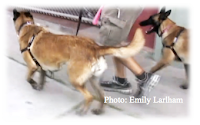 Myth: Harnesses make dogs pull. Truth: People who follow dogs in harnesses make dogs pull. Yes, in a back clipping harnesses dogs can get more force behind their pulling, and so when they do pull they can pull with more leverage. The only reason that dogs can’t pull as hard in a collar is because they are using their delicate organs and their spinal column to pull forward. There are many harnesses on the market today specifically for extremely strong dogs. If you clip the leash to a front clipping harness the dog cannot get as much leverage as clipping it to the back of a harness, and it is easier to reorient your dog towards you than when the leash is attached to the back of the dog. If you want your dog to pull you sometimes but not others (perhaps on a skateboard or in a wheel chair) you can put the behavior on cue or you could simply allow pulling when the harness is clipped to the back and not allow pulling when you clip the leash to the front of the harness.
Choose a well fitting harness that distributes weight evenly and that does not pinch or rub specifically on one area (for example in the armpits). Make sure not to buy the type of harness that tightens like a slip lead when the dog pulls in order to cause discomfort or pain. Halters that fit over a dogs head could also cause neck injuries but in a different way than a collar, as the neck is twisted to the side or back if the dog were to hit the end of the leash. Don’t buy a harness that rests on your dogs neck as it could be just as damaging to the throat as a collar, making wearing the harness instead of a collar pointless. Many suggest a prong collar is more humane as the dog will not pull, but if the dog were to pull once, all the pressure of the collar will rest on a few tiny points on the neck. What if that point were to rest perfectly on the center of your dogs’ jugular vain, or larynx. Shock collars are also not a solution because of the behavioral side effects that can occur. Shock collars are under investigation in many countries for being inhumane and banned in many parts of Europe (including Sweden where I live).
In conclusion
 If humane is defined as having regard for the health and wellbeing of another, then I believe that attaching a leash to the collar on your dog’s throat is not as humane practice as attaching the leash to a harness.
Walking a dog with a leash attached to their neck is just not worth the risk of the physical damage to your dog’s delicate neck, the organs housed within the neck, and the rest of the body that is affected by pressure on the neck.

On a final note, TRAIN your dog to walk with you. Don’t just put your dog in a harness to prevent pressure on the neck. Training a dog is a wonderful way to spend time bonding and interacting with your dog and should be one of the joys of companionship.
Please spread the word. Use a harness when you need to attach a leash to your dog!

Above pictures are of the authors dogs Trisch, Lacey, Tug, Splash and Kiko in their harnesses.
References:
Pauli AM, Bentley, E Diehl, KA, Miller, PE. Effects of the application of neck pressure by a collar or harness on intraocular pressure in dogs. J.Am.Anim.Hosp. Assoc.2006:42:207-211
Dr. Peter Dobias, DVM’s article ‘Dog collars can cause disease and possibly lead to cancer’ http://www.peterdobias.com/community/2011/07/dog-collars-can-cause-disease-and-possibly-lead-to-cancer/
“Dr. Peter Dobias has been in Veterinary Practice since 1988. In 2008 he sold his thriving holistic veterinary practice in North Vancouver, BC Canada to pursue his passion for educating the public about disease prevention and natural treatment methods. He also started a not for profit society aimed at animal welfare, holistic cancer research and educating the public on the dangers of choke and prong collars. He believes that together, we can create a healthy and long life naturally. Visit him at www.peterdobias.com or on facebook at www.facebook.com/drpeterdobias.”
Boyd JS (1991) Color atlas of clinical anatomy of the dog and cat. Mosby, London
Is Your Dog A Trouble Maker Please Read On For Several Superb Advice!
Training your dog is a universal skill that people who would like to raise your dog or dogs, in the family, need to acquire. Some dogs quickly learn and others are slow. There are numerous of methods to teach your dog, or dogs, and also the following will assist you to along the journey to gaining the skill sets you will need.
Dogs should continue to be trained in their lives. Many owners believe that once a dog is trained, hes trained forever. This simply isnt true. Daily reinforcement by reminding your dog of simple commands, exposing him to new people and providing positive reinforcement is vital. This will keep your dog well allow and behaved him to be a happy member of the family.
With the right practice and patience, your puppy is going to be walking right with you very quickly, even though the walk are often very tough to master. Firstly, do not allow these to leave the door first. When you put his leash on, make him sit first or provide you with his paw. To put it briefly, some form of obedience to get him inside the spirit. Then, when you find yourself actually outside, if he actually starts to walk in front of you, supply the leash a quick tug to assert yourself as being the one in charge.
When feeding your dog, always expect your pet to stay in a calm state and able to eat. Hyper activity at feeding time will never permit the pet to properly address feeding rituals. Begin a ritual of the calm animal who sits and waits patiently so that you can give food. After this behavior is taught, your pet dog probably will begin sitting patiently while you prepare their food.
When training your pet dog, it is imperative that you remain patient constantly. Moving too rapidly or losing your temper can confuse your dog and cause him to mistrust you. Without the proper trust, your pet will never fully submit to your training plus your relationship along with your dog will truly suffer.
Equally as reinforcement of excellent behavior when training your dog should be immediate, so too should punishment for bad behavior be immediate. If it message is delivered right after that act, saying "no" inside a harsh voice tells your dog he has acted inappropriately but he only connects the message with the targeted behavior.
Negative ways of training your pet dog dont work. In the same way with humans, positive reinforcement of behaviors is far more effective. Use treats, play and praise a chance to show your pet dog that you are currently satisfied with their performance. Usually do not punish him or yell at him if he cannot do what you are asking him. He will associate trying to do the task with negativity and will steer clear of the task even harder the next time.
When working on teaching your pet a command, keep training sessions short. It is much better to exercise your pet dog for five minutes, three times per day, than all in one 15 minute session. This will likely maintain your dog focused. Before your pet dog gets bored, end the session. This will likely keep him interested and wanting more.
Make sure your and you family are consistent with your commands. The dog will probably get mixed signals if one person uses "down" to share with the dog to obtain from the couch while another says "off" as well as a third is letting him lay there. This makes it much more a hardship on him to find out the commands.
Crate training is an excellent skill to get a dog of all ages to obtain. Teaching your dog to stay in their crate quietly takes patience and time but could be a valuable tool while potty training or even a safe area for him to be while you are out of the house.
Producing good puppy training involves a, encouragement and patience good reward system. What you ought to do is set up a quality reward system for when they are doing the proper things. Supplementing positive behavior with treats is a great way to start, and as time passes you are able to train these with a different reward system for example compliments and affection. The biggest thing to pay attention to is encouraging these people to perform the right thing.
Be mindful of methods long the sessions are once you train your puppy. Your dog is going to get bored doing the same thing again and again. Keep the original sessions limited by about 10 minutes.
Encourage your dogs cooperation in training by rewarding good behavior. Dogs answer a calm, confident leader who earns respect. Once your dog responds to commands ensure you reward him with play or food, and be sure you reward easy commands in addition to harder ones to build his confidence.
Not showering your dog with enough positive reinforcement when he does good, will minimize the power you possess over him in training. Since dogs love attention, offering them lots of it, provides him with incentive to listen for you. If all he ever hears by you is really what not to do, he or she is not getting any encouragement, only discouragement, so be sure you reward him with praise often.
A fantastic puppy training tip is to get rid of your dogs food dish. Dogs like in search of things. They enjoy to discover, and they like using their nose to get goodies. Your puppy may become much happier, by losing your dogs food dish and by hiding dog food throughout the house.
When training a pet dog, it is recommended not to enable the dog ignore a particular command. When the owner lets their pet disregard a command, the pet will receive inappropriate reinforcement. Your dog will quickly assume that its owners commands are optional. This works from the entire intent behind training a dog.
Conclusively, using suggestions from this information will end up being a successful part with your goal to train your pet dog or dogs. If you are in contact with different ideas and can experiment with different techniques using error and trial, you can find what meets your needs, through the training of your own furry loved one.
Read More..
Dogs should continue to be trained in their lives. Many owners believe that once a dog is trained, hes trained forever. This simply isnt true. Daily reinforcement by reminding your dog of simple commands, exposing him to new people and providing positive reinforcement is vital. This will keep your dog well allow and behaved him to be a happy member of the family.
With the right practice and patience, your puppy is going to be walking right with you very quickly, even though the walk are often very tough to master. Firstly, do not allow these to leave the door first. When you put his leash on, make him sit first or provide you with his paw. To put it briefly, some form of obedience to get him inside the spirit. Then, when you find yourself actually outside, if he actually starts to walk in front of you, supply the leash a quick tug to assert yourself as being the one in charge.
When feeding your dog, always expect your pet to stay in a calm state and able to eat. Hyper activity at feeding time will never permit the pet to properly address feeding rituals. Begin a ritual of the calm animal who sits and waits patiently so that you can give food. After this behavior is taught, your pet dog probably will begin sitting patiently while you prepare their food.
When training your pet dog, it is imperative that you remain patient constantly. Moving too rapidly or losing your temper can confuse your dog and cause him to mistrust you. Without the proper trust, your pet will never fully submit to your training plus your relationship along with your dog will truly suffer.
Equally as reinforcement of excellent behavior when training your dog should be immediate, so too should punishment for bad behavior be immediate. If it message is delivered right after that act, saying "no" inside a harsh voice tells your dog he has acted inappropriately but he only connects the message with the targeted behavior.
Negative ways of training your pet dog dont work. In the same way with humans, positive reinforcement of behaviors is far more effective. Use treats, play and praise a chance to show your pet dog that you are currently satisfied with their performance. Usually do not punish him or yell at him if he cannot do what you are asking him. He will associate trying to do the task with negativity and will steer clear of the task even harder the next time.
When working on teaching your pet a command, keep training sessions short. It is much better to exercise your pet dog for five minutes, three times per day, than all in one 15 minute session. This will likely maintain your dog focused. Before your pet dog gets bored, end the session. This will likely keep him interested and wanting more.
Make sure your and you family are consistent with your commands. The dog will probably get mixed signals if one person uses "down" to share with the dog to obtain from the couch while another says "off" as well as a third is letting him lay there. This makes it much more a hardship on him to find out the commands.
Crate training is an excellent skill to get a dog of all ages to obtain. Teaching your dog to stay in their crate quietly takes patience and time but could be a valuable tool while potty training or even a safe area for him to be while you are out of the house.
Producing good puppy training involves a, encouragement and patience good reward system. What you ought to do is set up a quality reward system for when they are doing the proper things. Supplementing positive behavior with treats is a great way to start, and as time passes you are able to train these with a different reward system for example compliments and affection. The biggest thing to pay attention to is encouraging these people to perform the right thing.
Be mindful of methods long the sessions are once you train your puppy. Your dog is going to get bored doing the same thing again and again. Keep the original sessions limited by about 10 minutes.
Encourage your dogs cooperation in training by rewarding good behavior. Dogs answer a calm, confident leader who earns respect. Once your dog responds to commands ensure you reward him with play or food, and be sure you reward easy commands in addition to harder ones to build his confidence.
Not showering your dog with enough positive reinforcement when he does good, will minimize the power you possess over him in training. Since dogs love attention, offering them lots of it, provides him with incentive to listen for you. If all he ever hears by you is really what not to do, he or she is not getting any encouragement, only discouragement, so be sure you reward him with praise often.
A fantastic puppy training tip is to get rid of your dogs food dish. Dogs like in search of things. They enjoy to discover, and they like using their nose to get goodies. Your puppy may become much happier, by losing your dogs food dish and by hiding dog food throughout the house.
When training a pet dog, it is recommended not to enable the dog ignore a particular command. When the owner lets their pet disregard a command, the pet will receive inappropriate reinforcement. Your dog will quickly assume that its owners commands are optional. This works from the entire intent behind training a dog.
Conclusively, using suggestions from this information will end up being a successful part with your goal to train your pet dog or dogs. If you are in contact with different ideas and can experiment with different techniques using error and trial, you can find what meets your needs, through the training of your own furry loved one.
The hunt is on for my top dog!
I love Easter... Why? Because I get to play "dog mom" to my little one Poncho. I know I know, even though I am a positive reinforcement dog trainer here in Ventura at The Inquisitive Canine. I do know Im an over-the-top dog mom too. Every Easter I like to set up a "kibble hunt" for Poncho in our back yard. This is actually something I often do for him as an "enrichment" activity. But its special for me today because 1) it takes me back to my own childhood... 2) makes me feel part of the crowd with the rest of my friends that have *hunts* with their human kids...

Read More..
This time I allowed him to watch me set up the hunt...a little different from years past. Why? Not sure...just felt like it. Anyway, I started out by leashing him to the bench in the yard - then walked around dropping and placing pieces of his kibble (and a few extra yummy treats) in various places in the entire backyard. Under plants, between rocks, behind furniture... He was going wild! Very excited throughout... Kept offering a sit and down stay for me (check out the picture). He has learned that these two behaviors get rewarded - a lot, so why not keep offering them... I love that he has figured out how to make the right choices... (something I teach in my dog training classes) Anyway, once I let him go Poncho was all over it! Kept him busy for quite awhile - tapping into that predatory drive, fulfilling those desires to hunt...plus kept him out of my hair long enough to have my own breakfast. He has to eat anyway, right? I just like to use his meals to my advantage while making it more fun for him...
This is an activity I recommend for my clients - you too can learn more about enrichment, and preventing the "boredom blues" in the classes I teach at my rockin indoor dog training studio - The Inquisitive Canine...
Langganan:
Postingan (Atom)