


 If pulling on the collar is damaging to dogs’ necks, why don’t they stop pulling?! Dogs are not humans and do not operate behaviorally in the same way we do. It would be commonsense for us humans to stop when we hear ourselves gagging. Our anatomy is similar physically, however our brains are very different. We cannot make assumptions about dog’s behavior based on how we behave. If you grabbed an office worker by the tie, he wouldn’t suddenly start madly puling in all directions going red in the face to get to the walls to pee on them or strain and scream to get to the female office workers in the building or repetitively hit the end of his tie again and again to see if they could reach the free doughnuts in the lunch room until he flipped himself onto his back. I have seen dogs walk on their two back legs with their weight shifted onto the collar to get somewhere. I have seen dogs pull so hard that they cannot get a breath into their lungs and dogs drawing in rasping breaths. I have also seem people jerk their dog so that their dogs whole body lifts off the ground, and as soon as the dog is on the ground again, he is hitting the end of the leash to get to that other dog on the other side of the street.

 possibility that dogs correct each other as a reflex, or simply because it has been reinforced in the past. Also, one should be warned that some dogs will become aggressive when other dogs bite them no matter what the reason.

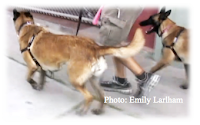 Myth: Harnesses make dogs pull. Truth: People who follow dogs in harnesses make dogs pull. Yes, in a back clipping harnesses dogs can get more force behind their pulling, and so when they do pull they can pull with more leverage. The only reason that dogs can’t pull as hard in a collar is because they are using their delicate organs and their spinal column to pull forward. There are many harnesses on the market today specifically for extremely strong dogs. If you clip the leash to a front clipping harness the dog cannot get as much leverage as clipping it to the back of a harness, and it is easier to reorient your dog towards you than when the leash is attached to the back of the dog. If you want your dog to pull you sometimes but not others (perhaps on a skateboard or in a wheel chair) you can put the behavior on cue or you could simply allow pulling when the harness is clipped to the back and not allow pulling when you clip the leash to the front of the harness.
 If humane is defined as having regard for the health and wellbeing of another, then I believe that attaching a leash to the collar on your dog’s throat is not as humane practice as attaching the leash to a harness.


Walking Your Dog on Leash Doesnt Have to Be a Huge Production
"My dog pulls like a maniac when I walk him on leash!" "My dog barks at everything when were out walking." "My dog wants to pull me down the street whenever she sees something run by - even a leaf!"
These comments are just a few examples of what I hear every day from various dog owners. Whether it be attendees in my dog training classes, my private dog training clients, or those who have written in to the dog behavior advice column Poncho and I write for, everyone seems to be in the same leash-pulling-boat.

As Ive said in other posts about walking dogs on leash: "Dogs werent born knowing how to walk on leash. And us humans werent born knowing how to use one." Then why is it we think we can just leash up our dogs and head right out the door into a world that, to our pet dogs, is probably more like an amusement park than anything else, and think they would understand exactly what we want? To me, a certified professional dog trainer, this is one of those "unrealistic expectations" kinda moments. Leash walking is an art, a science, and definitely an act that requires practice! And just like any new skill, its best to start out slow and simple, and then build as you (and your dog) progress along.
I like to break down the leash walking behavior I teach my dog training students into three sections.
- First and foremost: Reward what you want!!!! If you want your dog walking next to you, then reward him or her with yummy treats while they are next to you. Lure your dog into position and reward them. Its that simple.
- STOP! If and when your dog does pull, stop dead in your tracks! They will soon learn that pulling gets them nowhere, but walking next to you gets them yummy treats and walkies.
- Use your dogs environmental motivators as rewards! Okay, remember, our dogs walkies should be about them, and not always about us. They want to sniff? Mark? Say hello to another person or dog? Roll in something dead? Well shoot, use that to your advantage. Ask for a "sit" or "Watch me", then allow them to go and do their doggy thing. It doesnt always have to be about food.
Using Leash Training To Your Advantage
When you brought your pet dog home, you had been probably having visions of Lassie, but there have probably been days that you were remembering Cujo more. However, theres still hope! A bit of training goes a considerable ways in reducing bad dog behavior.
In order to train your puppy, it can help when you can think just like a dog. In case your dog will not be doing the standard stuff you teach it, its an easy task to get mad. Try and think how your pet does. Consider how it might be to view the planet inside their eyes. This will offer you a completely different perspective, that ought to help you in training them.
Young puppies are given to chewing on the owners belongings. If he chews an inappropriate item, you are able to address this issue by immediately stopping your puppy. You shouldthen and instead, supply him with the toys that he is allowed to chew. Praise your pet dog whenever you finding him chewing a permitted toy. Remaining consistent with this particular training method will save your best furniture or footwear.
Watch what kind of activities you are encouraging your pet to complete. Sometimes we might perform actions with the dog without realizing they are training those to take steps we dislike. If each and every time your dog chews something up you send him outside, you are teaching him that chewing something up is key for you to get outdoor time. Be mindful together with the actions you are taking, especially ones that are usually consistent practices.
Prepare to administer lessons to your dog repeatedly. Most dogs will not get a whole new command with only 1 or 2 tries. Sometimes it is helpful to focus on 1 or 2 commands every day to ensure via your sessions you might be repeating enough times to repair the commands solidly inside your dogs memory.
Tend not to repeat the command repeatedly just before getting a response, when giving commands in your dog. Through giving the command once and awaiting the dog to respond, you will teach him that you are expectant of the behavior. When the command is not really obeyed at the beginning, show the family pet everything you expect before saying the command again.
It requires many repetitions before your dog can learn new commands. It isnt uncommon for 25-50 repetitions on this same command to use for the dog to comprehend it. Keep teaching it and be patient. The canine will learn with time.
Producing good training your dog involves patience, a and encouragement good reward system. What you should do is set up a quality reward system for while they are doing the best things. Supplementing positive behavior with treats is a wonderful way to start, and over time you are able to train these with another reward system for example affection and compliments. What is important to concentrate on is encouraging them to perform the right thing.
To help you train your pet dog, you must assert yourself as the dominant one in your relationship by refusing to give the dog undeserved attention or food. Whenever you convince your pet dog you manage the show and, furthermore, let the dog recognize you can utilize that power to give it something it wants, your pet dog will obey your commands better.
Be consistent when training your dog. Always give commands utilizing the same words, in the same tone of voice. Know that your pet will not learn commands instantly. You must show him what you would like. As an example, if you want him to discover to make right and left on command when walking, you have to say, "left" or "right" every time you come up with a turn. Eventually, your dog can get you drift!
Never yell in a barking dog. While a barking dog will definitely boost your frustration level, resist the impulse to yell their way. Dogs tend not to understand that you will be yelling their way, and sometimes associate your raised voice as you joining inside the fun of barking. Should your dog is barking, calmly distract these with a toy or treat, and when the barking stops, allow them to have their prize.
It is going to sometimes be counterproductive when you pour excessive information and training into the puppy. Puppies have short attention spans, therefore keep your sessions short and supply ample levels of praise. Should you do excessive the puppy will just forget what you have taught him, and remember it within a negative way, it will probably be harder to aid him ultimately.
Some dogs have enormous reserves of energy that can induce the canine to act crazy through out of the day. For dogs like this a fenced in yard or electric collar fence can be quite a great tool to allow the dog to run around inside a contained area. Your pet could have more exercise and become more enjoyable when it comes inside.
Underestimating the need of good exercise will cramp your dogs training style. Naturally, all dogs must run, chase and play simply to release energy so if they are doing not get enough exercise outside training they are very probably be distracted or over excited and result in the session to get frustrating for anyone.
A fantastic puppy training tip is usually to be perceptive regarding what dog foods and treats your pet dog likes. Exactly like humans, not all the dogs just like the same foods. There are a variety of different dog treats. Try experimenting with different dog treats to find out which ones your pet likes by far the most.
Once you start applying these pointers you will be impressed by the outcomes. Experiment with these guidelines in case you are having problems with the dog.
How to Walk Your Dog on A Loose Leash
One of the biggest problems people have with their dogs is poor leash manners. I often see owners being dragged down the street, while their dog pushes, pulls and runs to and fro racing from one area to another; that is not an enjoyable situation for the human! Pulling can also be dangerous not only for the human and their rotator cuff, it can damage the dog’s windpipe permanently. It is, after all, the human who is taking the dog out for a walk, it should be just as enjoyable if not more so for them than their dog!
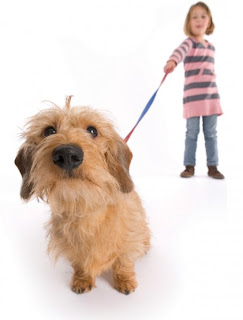 When I take my dogs out, I see it as a privilege not something that is owed to them, it is MY walk and I am inviting them to join me on my excursion. Keep this in mind when walking your dog, it is about you, and your dog should learn if he is good and respectful of you he can come along to enjoy your time.
First things first, you must teach your dog about leash walking. In my opinion, the most important facet of leash walking is “THE LEASH” it is essential to me that the leash is always the same length, meaning I never train with a flexible leash. My dogs must know exactly how many feet they have before they are at risk of pulling me.
 |
| walk your dog on a loose leash |
Loose Leash Step 1

 |
| walk your dog on a loose leash |
 We have a tendency to want to pull or strangle our dogs and put constant pressure on their collar, which forces them to pull back. If you grab and pull someone, they pull away, it is instinct. Don’t pull on your dog! Make it almost impossible for you to strangle your dog by using the opposite hand to hold the leash. Put treats into your left hand so that you can reach down and put them in front of your dog’s nose. Admittedly, this takes some grace and skill which may elude you at first, but with practice you will get it down.
Loose Leash Step 2
 With the leash in your right hand, draped across your body and hanging loosely from your dog’s collar, grab a handful of treats and stick them next to your dog’s nose and lure him forward 3 steps with the treat, then stop and release the treat. Continue doing this for two to three steps at a time. You may also start to ask him to sit when you stop. Once your dog has the idea, you can begin taking more steps. If your dog chooses to be next to your leg and is not pulling, reward with praise and treats. Change your pace, make some left and right turns and make this fun by rewarding your dog for following your hand.
Loose Leash Step 3
If your dog is not paying attention, play a fun game of keep away! If my dog is not watching me and starts to go forward, I turn around and change my direction. My dog will soon wonder where I went and try to catch up to me. If he looks to the left and I think he is going to start to go that direction, I go to the right.
 |
| walk your dog on a loose leash |
Loose Leash Step 4
 This is a training exercise, don’t expect to go on an actual walk with a destination. You will be changing your direction and turning around often so understand that distance is not the goal. Walking in a straight line is BORING!! Even at its best, or fastest pace one direction is a yawn fest for your dog, which is why his nose wanders and he tries to find something else to entertain him. Stimulate his mind by changing your direction, making a circle to the left or to the right, throw in some left turns and some right turns, stop and ask him to sit or down. If you mix in some obedience and turns, it makes it fun and exciting for your dog, your dog will never know what is coming next so he is more likely to pay attention to you. He lives for diversity, give it to him and make it fun!
  If you teach him that sticking by your side and following you around is exciting and fun and brings rewards and praise, he will choose to be there by you. If he drifts off and looks like he is going to begin to pull, go the other way. If you are having problems, ask yourself if you are boring him to tears, and if the answer is “yes”, then make it more fun for each of you. You will both benefit from adding more obedience and even advanced obedience to your regiment!
So how do you walk your dog now, we hope it is now a matter of time that you will master the technique, with the little help from this how to walk your dog on a loose leash information, we all hope so.
How to Use the Leash in Training
To your success in dog training