Is it harmful to attach a leash to your dog’s neck?
By Emily Larlham
(Note: This article is a work in progress- the more I research, the more I will add to this work.)
People who live with dogs for companionship and friendship all want what is physically and psychologically best for their dog. We get dogs as companions in order to experience friendship, trust and to take care of another living creature that depends on us for their wellbeing. Many of us have a sense of pride when it comes to taking care of our beloved dogs, so finding out about information that conflicts with how we are already caring for our pet can feel like a personal affront.
I used to walk dogs with the leash attached to a collar or slip lead until I was confronted by someone who suggested I use harnesses instead to prevent neck injury. I felt harassed, annoyed and in disbelief that this ‘know it all’ dare lecture me on how I take care of dogs, because I love my dogs dearly! I also felt a feeling of shame from the social interaction of being told I was doing something wrong by a stranger in a public place. Although the information hurt, a seed was planted in my brain and it began to grow. It has only been a handful of years since I started using only harnesses on dogs and wince when I see a dog hit the end of their lead on a collar.
In this article I will attempt to convince you for your dog’s quality of life and physical wellbeing to not to attach a leash to your dog’s throat. Be it for any reason such as obeying leash laws, managing behavior, or being in a serious rush to get out the door. I strive to put forth the information in a way that will not cause the reader the feelings I felt when I first was asked to consider using a harness instead of a collar.
Aren’t dog’s necks constructed differently than ours?
A main argument I have heard for the use of collars is that dog’s necks are sturdy, strong and not like our necks at all. In actual fact, the neck of a canine is physiologically similar to that of a human. Our general anatomy is so similar to dogs that human medicine has been tested on dogs. Get down on all fours and gently feel your dog’s neck while you are feeling your own. Both of our necks contain the trachea, oesophagus, thyroid gland, lymph nodes, jugular veins and spinal column relatively within the same places. Both contain muscles in relatively the same places.
A dog’s skin is very similar to ours too. Obviously dogs are hairier than us and do not sweat, but the skin is almost exactly the same apart from the epidermis of a dogs skin being only 3-5 cells thick when our top layer of skin is 10-15 cells thick.
Can attaching a leash to a collar on your dog’s neck be physically harmful?
Attaching a leash to a dog’s collar can indeed cause physical harm to your dog if the dog were ever to hit the end of the leash or pull on the leash. This is because the neck of a dog is full of very delicate and important physiology that keeps your dog healthy. The thyroid gland for example is located in the front of the neck below the larynx. Just one incident of pulling on a collar could possibly cause severe damage to your dog’s health in the same way as damage to your own neck could cause lasting health issues for you. Why would you take that risk? The only real benefit of having your dog wear a collar rather than a harness is that it is faster and easier for the dog’s handler to put on for a walk.
The Dangers of Using Collars:
Neck Injuries- Just one incident of pulling or running fast to the end of the leash could possibly cause serious neck damage. Neck injuries could include bruising, whiplash, headaches, crushed trachea, damage to larynx, and fractured vertebrae. A neck and spinal cord injury can cause paralysis or neurological problems.
In a study of 400 dogs by Anders Hallgren published in “Animal Behaviour Consultants Newsletter” in 1992, he found that “Pulling and jerking on the leash affect especially the neck and throat in the dog. As expected, there was no correlation between leash handling and thoracic/lumbar defects. However, one of the clearest correlations in the whole study was between cervical (neck) damages and jerk and pull. 91% of the dogs who had neck injuries had also been exposed to jerking on the leash by the owner or been allowed to pull hard on the leash for long periods of time.” “Playing is harmless ? but warm up first. Dogs that often run, play with other dogs, jump out of happiness or over obstacles, showed no correlation with back problems. This is encouraging. However, dogs should be given massage and a chance to warm up before strenuous activities, whether its before rough playing, hunting or agility.”
Ear Issues- In the study by Pauli AM, Bentley, E Diehl, KA, Miller, PE ‘Effects of the application of neck pressure by a collar or harness on intraocular pressure in dogs’, it was found that pressure in the eyes “was significantly increased from base-line values when a force was applied to the neck via a leash to a collar, but not to a harness, in the dogs of this study.” This type of intraocular pressure can cause serious injury to dogs already suffering thin corneas, glaucoma, or eye injuries.
Eye Issues- Dr. Peter Dobias, DVM states in an article ‘Dog collars can cause disease and possibly lead to cancer’ which can be found here: http://www.peterdobias.com/community/2011/07/dog-collars-can-cause-disease-and-possibly-lead-to-cancer/, that “Ear and eye issues are frequently related to pulling on the leash. When dogs pull on the leash, the collar restricts the blood and lymphatic flow to and from the head.”
Hypothyroidism- The collar rests on the neck in the area of the thyroid gland. As Dr. Peter Dobias says in his article, “This gland gets severely traumatized whenever a dog pulls on the leash, it becomes inflamed and consequently “destroyed” by the body’s own immune system when it tries to remove the inflamed thyroid cells. The destruction of the thyroid cells leads to the deficit of thyroid hormone – hypothyroidism and because the thyroid gland governs the metabolism of every cell. The symptoms may be low energy, weight gain, skin problems, hair loss and a tendency to ear infections and organ failure.”
Malfunction of the nervous system in the forelimbs- Another health issue that Dr. Dobias points out in his article on collars is the possibility of malfunction of the nervous system in the forlimbs. He states, “Excessive paw licking and foreleg lameness can also be related to your dog’s collar. Leash pulling impinges the nerves supplying the front legs. This can lead to an abnormal sensation in the feet and dogs may start licking their feet. These dogs are often misdiagnosed as allergic and all that needs to be done is to remove the collar and treat the neck injury.”
Behavioral Problems- It is commonly believed that in all animals with a brain, behavior is linked to health. In Anders Hallgren study published in “Animal Behaviour Consultants Newsletter” in 1992, he found correlations between injury and behavior. Anders writes, “That dogs are so similar to humans may come as a surprise to many.” “A common cause of behavioral troubles in dogs is disease or pain. According to those who work with problem dogs, the most usual source of pain
and disease is damage to the muscles and bones.” Anders study was focused on back injuries. Of the group of 400 dogs, 79% of the aggressive dogs had back problems, while 21% had no back problems. Of the reserved shy dogs 69% had back problems while 31% had no back issues. This study shows that there is a correlation between physical health and behavioral problems.
If it’s damaging their necks, why don’t they stop pulling?!


If pulling on the collar is damaging to dogs’ necks, why don’t they stop pulling?! Dogs are not humans and do not operate behaviorally in the same way we do. It would be commonsense for us humans to stop when we hear ourselves gagging. Our anatomy is similar physically, however our brains are very different. We cannot make assumptions about dog’s behavior based on how we behave. If you grabbed an office worker by the tie, he wouldn’t suddenly start madly puling in all directions going red in the face to get to the walls to pee on them or strain and scream to get to the female office workers in the building or repetitively hit the end of his tie again and again to see if they could reach the free doughnuts in the lunch room until he flipped himself onto his back. I have seen dogs walk on their two back legs with their weight shifted onto the collar to get somewhere. I have seen dogs pull so hard that they cannot get a breath into their lungs and dogs drawing in rasping breaths. I have also seem people jerk their dog so that their dogs whole body lifts off the ground, and as soon as the dog is on the ground again, he is hitting the end of the leash to get to that other dog on the other side of the street.
Some dogs would chase a ball or herd sheep until they died from overheating. I know dogs that have broken off their teeth trying to get through fence or crate, and dogs that have ripped out their toenails scratching at the door when an owner left for 5 minutes. My border collie ripped off the pads of her feet while playing in the desert and did not show any behavioral signs of injury until she got up from a nap, and I realized the pads of her feet were gone. If you have watched the show Animal Cops you might have seen abuse cases of ingrown collars and severe neck lacerations, where dogs are walking around normally as if nothing happened with a huge gaping neck wound. Dogs do not exhibit or react to injury in the same ways we do.
How can we know what a dog is experiencing? Is there a way we can measure pain or suffering?
There is no reliable way of measuring suffering or pain in animals, or humans for that matter. The most reliable way to measure pain and suffering in humans is through verbal communication with the patient. MRI scans of the brain can also shed some light on how others feel. Measuring cortisol levels or stress hormone levels have proven to be an unreliable way to measure pain or suffering, as they are just too unpredictable in studies. For example, in human abuse cases stress levels could either be higher or lower than average and conclude nothing. The same unpredictable results can happen when measuring stress in dogs. Therefore at this point in time there is no reliable way to scientifically deduce the psychological implications caused by wearing a collar. All we know is that behavior can be affected by the physical health of a dog.
If dogs bite each other shouldn’t it be natural for us to emulate them to train them?

It all depends on your morals and ethics whether inflicting intimidation or pain on an animal is an acceptable behavior. It is part of human behavior in a society to bully, rape and kill each other, but that doesn’t make it moral or give one the right to do it to other people. Because dogs and wolves bully, fight, and kill each other does not make it acceptable for us to emulate their behavior towards our own dog. Dogs play-fight using their mouths, see the photo above left, but that also doesn’t give us a right to use collars or intimidation to manage or train dogs. Jerking a dog on a collar could suppress a behavior from happening, but it can also cause behavioral side effects such as aggression and frustration. Non-violent ways of training dogs exist that don’t have unwanted side effects. There is a myth that all dogs correct each other. There are some dogs that correct other dogs, and other dogs that don’t. You can train multi dog households to cohabit the same spaces peacefully and actually enjoy being in each other’s presence using Classical Conditioning, instead of letting the dogs work in out on their own.
Jerking a collar around a dog’s neck does not emulate the biting of another dog physiologically either. Many trainers hope to emulate dog corrections to train a dog to stay with them or train new behaviors, but dogs do not bite one another to get the other to stay with them or to train them to offer specific behaviors through out the day. We don’t even know if dogs consciously know their actions affect another dog’s behavior in the future. There is the

possibility that dogs correct each other as a reflex, or simply because it has been reinforced in the past. Also, one should be warned that some dogs will become aggressive when other dogs bite them no matter what the reason.
Then how do I punish my dog if he pulls?
There is a way of training animals that involves no form of physical or psychological intimidation called Progressive Reinforcement Training. Please read the Progressive Reinforcement Training Manifesto at www.dogmantics.com for more information.
To solve leash pulling you can reinforce your dog for being at your side with well-timed treats and the reward of getting to move forward. You can then “punish” the behavior of pulling, by not moving an inch in the direction that the dog begins to pull in and instead move backwards. There is no need to intimidate or hurt a dog to teach him to walk on a leash. The main goal is to never follow a dog on a tight leash, even one inch, as it will teach the dog that leaning into the leash will yield the reward of getting to where he wants to go and he will repeat the behavior in the future. Leash pulling problems can also be the side effects of other behavioral problems such as fear, anxiety or over arousal, so a trainer needs to get to the heart of the problem rather than work on only the side effects. There are multiple free leash walking tutorials here if you need assistance: www.youtube.com/kikopup
Here is one basic leash walking video: http://www.youtube.com/watch?v=sFgtqgiAKoQ
But my dog never pulls on leash…
Yes, perhaps there is a dog out there, that will never ever pull suddenly towards a smell in a bush, food on the ground, an old friend or another dog. But there might be some time in that dogs life that the dog might need to be pulled, perhaps a car mounts the sidewalk and you need to jerk your dog out of the way or perhaps a car back fires and your dog runs forward. We would never attach a leash to a child’s neck to keep him safe, why would we attach a leash to a dog’s throat when there is the option of a harness. In the same way a human’s neck could get severely damaged if we fell forward onto a collar attached to a lead, a dog can suffer the same harm.
Make a choice for your dog’s wellbeing- Choose a harness!

Myth: Harnesses make dogs pull. Truth: People who follow dogs in harnesses make dogs pull. Yes, in a back clipping harnesses dogs can get more force behind their pulling, and so when they do pull they can pull with more leverage. The only reason that dogs can’t pull as hard in a collar is because they are using their delicate organs and their spinal column to pull forward. There are many harnesses on the market today specifically for extremely strong dogs. If you clip the leash to a front clipping harness the dog cannot get as much leverage as clipping it to the back of a harness, and it is easier to reorient your dog towards you than when the leash is attached to the back of the dog. If you want your dog to pull you sometimes but not others (perhaps on a skateboard or in a wheel chair) you can put the behavior on cue or you could simply allow pulling when the harness is clipped to the back and not allow pulling when you clip the leash to the front of the harness.

Choose a well fitting harness that distributes weight evenly and that does not pinch or rub specifically on one area (for example in the armpits). Make sure not to buy the type of harness that tightens like a slip lead when the dog pulls in order to cause discomfort or pain. Halters that fit over a dogs head could also cause neck injuries but in a different way than a collar, as the neck is twisted to the side or back if the dog were to hit the end of the leash. Don’t buy a harness that rests on your dogs neck as it could be just as damaging to the throat as a collar, making wearing the harness instead of a collar pointless. Many suggest a prong collar is more humane as the dog will not pull, but if the dog were to pull once, all the pressure of the collar will rest on a few tiny points on the neck. What if that point were to rest perfectly on the center of your dogs’ jugular vain, or larynx. Shock collars are also not a solution because of the behavioral side effects that can occur. Shock collars are under investigation in many countries for being inhumane and banned in many parts of Europe (including Sweden where I live).
In conclusion

If humane is defined as having regard for the health and wellbeing of another, then I believe that attaching a leash to the collar on your dog’s throat is not as humane practice as attaching the leash to a harness.
Walking a dog with a leash attached to their neck is just not worth the risk of the physical damage to your dog’s delicate neck, the organs housed within the neck, and the rest of the body that is affected by pressure on the neck.
On a final note, TRAIN your dog to walk with you. Don’t just put your dog in a harness to prevent pressure on the neck. Training a dog is a wonderful way to spend time bonding and interacting with your dog and should be one of the joys of companionship.
Please spread the word. Use a harness when you need to attach a leash to your dog!
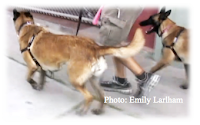
Above pictures are of the authors dogs Trisch, Lacey, Tug, Splash and Kiko in their harnesses.
References:
Pauli AM, Bentley, E Diehl, KA, Miller, PE. Effects of the application of neck pressure by a collar or harness on intraocular pressure in dogs. J.Am.Anim.Hosp. Assoc.2006:42:207-211
Dr. Peter Dobias, DVM’s article ‘Dog collars can cause disease and possibly lead to cancer’ http://www.peterdobias.com/community/2011/07/dog-collars-can-cause-disease-and-possibly-lead-to-cancer/
“Dr. Peter Dobias has been in Veterinary Practice since 1988. In 2008 he sold his thriving holistic veterinary practice in North Vancouver, BC Canada to pursue his passion for educating the public about disease prevention and natural treatment methods. He also started a not for profit society aimed at animal welfare, holistic cancer research and educating the public on the dangers of choke and prong collars. He believes that together, we can create a healthy and long life naturally. Visit him at www.peterdobias.com or on facebook at www.facebook.com/drpeterdobias.”
Boyd JS (1991) Color atlas of clinical anatomy of the dog and cat. Mosby, London

 Yeah my husband thinks I am touched to buy him a fancy collar since it isnt exactly easy to see. But hey, he deserves new bling now and then to. Even if we cant see much of it. Here it is:
 I got it at my favorite local pet boutique the Loyal Biscuit. It is the martingale "Punk Skulls" by Murphy & Gus. Slightly ironic given Jacks laid back nature. I just liked the "tattoo" look of the design.
 Im resisting going back for the matching leash. But at least that you would be able to see!

 I just read a question posted to a reporter news feed about wanting opinions from animal professionals on the topic of dressing dogs up... Okay, so this just happened to fall on the birthday of my beautiful, handsome, lovely, love of my life, baby boy


 Rewarding your dog is the finest way to get him to adhere to your commands. Of coursework, you also must be persistent. Canines discover greatest by repeating actions over & over again. Dont despair, prior to you know it, they are going to be well trained & properly behaved. Your dog can be like other brilliant & incredible canines out there as lengthy as you devote top quality time training him & rewarding him.
 Go ahead & talk to some close friends who have trained their canines. Ask them what they think of these books. They will definitely recommend a specific dog training book that could be helpful in coaching your own dog.


