So, with the flu in full-bloom, and classes shut down as a precautionary measure, Im sure my dog students (and their humans!) could use some training inspiration. I know you have all worked on some of this, but here is an entire, blow-by-blow, breakdown of steps to practice to get your dogs door manners up to speed. If you try it, please make a video recording of your best effort and share it on your blog! Or, send it to me, and I may share it on mine :)
Improve Your Dog’s Behavior at the Door
Peggy Moran
Before Starting:
On Your Marks! Be sure you have “charged your mark” using classical conditioning. To do this pair a novel stimulus, such as a sound (we use a “clicker” as our marking device) paired with a reward that immediately follows (we like to initially use very high value food rewards, such as small bits of cooked meat). You can add other mark/ reward pairings to your training toolbox. For example, we use an enthusiastic “yes!” with a toy that we toss or offer and tug; warmly stated “good job” with petting; and enthusiastic “okay!” with freedom. You will sound your mark at the exact instant your dog performs a wanted (by you) behavior, immediately followed by the associated promised reward. This will help your dog want to repeat that preceding action!
Get Set! You need to work on your training too, and it can be challenging to break old habits. One of the hardest new pieces of advice our students struggle with is NOT TALKING! Be aware, we do not add spoken word cues until later in the training; in the meanwhile what you do in a given situation becomes the cue! Since dogs don’t speak words anyway, it is best to build cues right into your training situations, and let body language—your dog’s first language!—do the talking for you. Later we do add spoken cues to use as prompts, but that happens only once your dog has gotten really good at a wanted behavior pattern. Adding the cue too early associates the cue with a less-than-perfect version of the behavior. I know it is hard, but try to keep as quiet as possible, other than marking and praising wanted behaviors.
Go! Follow these steps, practicing with patience, affection, and well-timed marking and rewards, and soon your dog will have the best door manners you could ever imagine:
1. Encourage your on-leash dog to approach the closed door, using a hand target (palm facing dog, back of hand touching the door at dog’s nose height); as dog touches your hand (or with a beginner, makes effort in the right direction), click and reward.
2. Touch and rattle your doorknob, then toss a bit of food away from the door. Mark as your dog moves toward the food. You may opt to use a throw rug as a designated “place” for your dog to go in response to the doorknob/ back up cue, in which case toss the food onto the rug and mark when the dog contacts it. As this behavior gradually evolves through shaping, you can move the “place” further back, or shape for a sit or down response. Repeat 1, 2 pattern many times in a row.
3. Open your door, and begin immediately backing away from the open door until your dog turns to face and follow you; click and reward. Repeat 1,2,3 pattern many times in a row.
4. Progress to open door, and prompt let’s go as your dog crosses the threshold; immediately stop and loop her back into the house without saying anything; click and reward inside the house. Repeat step 4. many times in a row.
5. Proceed toward the open door holding the leash loosely in your left hand; as you step out the door don’t say anything nor obstruct your dog; but do counter your dogs urge to from follow you across the threshold by repeating your earlier tossing of treats to coincide with your step across (barely!) the door threshold; click and reward your dog for NOT going outside without a permission prompt. Practice a pattern of 4,4,4,5 many times in a row.
Adding New Door-Related Challenges:
Alternate door stimuli/ triggers:
A-1. After step 2, above, knock slightly on your own door frame, and deliver an immediate food reward. This is a classical conditioning exercise, and does not require you to click before delivering the food reward. In this case the knocking will become a new “click”. Repeat MANY times; if your dog becomes overly reactive, or too distracted to accept food, reduce the intensity or duration of your knocking. You may have to just lightly tap once, to start. Gradually build up intensity, with the goal being to keep your dog under threshold.
A-2. Repeat the above exercise using your doorbell. You may need to begin with a family member ringing the doorbell as you give the food reward. Repeat many times, while behaving cheerfully each time the bell rings. Ignore any reactivity, such as barking, and deliver food regardless of the dogs mood and/ or behavior. The goal is not to reward certain behaviors (or the absence of unwanted ones); it is to change the way the dog perceives the doorbell, converting it to a conditioned stimulus that signals “food is coming!”. Your dog’s behavior will change for the better once the dog has a new, food-expectant rather than defensive, emotional response to the stimulus.
A-3. Shape your dog’s behavior, using the knock or the doorbell ring as a signal to go to “place”. following the steps from 2, above.
Guests at the door:
Note: The following practices are only appropriate for dogs who are friendly with strangers.G-1. A training helper may perform the role of a visitor at the door; follow steps 1,2 and 3, above; at 3, as you open the door, invite your guest to come in, and proceed to back away until your dog follows you, disallowing greeting/ jumping all over your guest; click and reward.
G-2. Proceed toward the guest, and as you draw close, click and drop a food reward at your guest’s feet.
G-3. Back away again, then repeat step G-2 many times.
G-4. During one of your approaches to your guest, give them a handful of your food rewards. After repeating G-3 several times, approach the guest, click, and allow them to place the food reward on the floor in front of their feet. Ask them to temporarily refrain from petting or speaking to your dog. Repeat several times.
G-5. Approach the guest, click and allow the guest to hand-deliver the food reward. Repeat several times.
G-6. Repeat all of the above steps, but do so with your dog in “place”, with your guest approaching your dog, rather than your dog approaching the guest.
Practice frequently, and enjoy your dog!


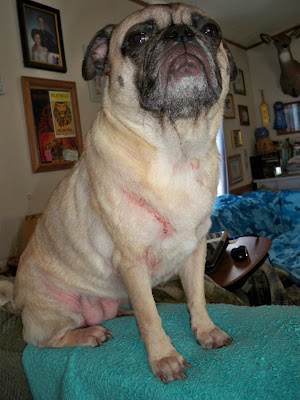 The top photo is from today. The two below are from Sunday evening.


 My friend Emilia just emailed me a great photo of her dog


 Two t-shirts from the sale table (only $10 each!) and a book on allergies in dogs. Score!! It was a great side trip for sure.
 And while I am showing off stuff Ive scored here is my latest acquisition from T.J.Maxx. It is a new set of couch steps for Jenny. One of the errands we were doing was to pick out our 2 new leather couches and the ugly plastic set of steps wasnt going to cut it anymore. I nabbed this for only $15! I did add the no-slip grip tape to the top and some no slide on the bottom so it wont slip on the floor. Isnt it cute?