Tampilkan postingan dengan label with. Tampilkan semua postingan

How to Fade A Lure when training with food


1 Get RID of the lure as soon as you can! The goal is within 3 trials. 

2 If you dont have a clicker use a very short word like "yes!" or "yep!" 

3 Always make it harder and harder, dont get stuck at the same level of criteria

4 If you go to far to quickly you can always go back a step

5 If your dog is not following the lure, get a smellier lure- real meat!
Read More..

How To Deal With Your Dogs Housebreaking Issue

If your dog accidentally eliminate in the night, consider the following:

Do not let your dog have any food or water at least two hours before bedtime
Take the dog out for his final walk and elimination as late as you possibly can
If need be, put him in a crate. Remember the size of the crate should be just enough for him to stand up, turn around, lie down and comfortably stretch out but no bigger than that.


Crate training is effective since most dogs do not like to eliminate where they have to lie. If the crate is large enough, he may eliminate if there is a clean spot for him to lie down.

For an effective housebreaking training, it involves:

Positively reinforcing the correct behaviour – praising him when he eliminates in the proper place
Managing him by preventing him from eliminating in the wrong place until you take him out to eliminate at the right place.
To do so:

Confine your dog in a crate
After a few hours, take him from the crate to the location you want him to eliminate in.
Remember to take your dog out the same door to the same location every time you want him to eliminate
Wait for 10 minutes for him to eliminate
When he does it within 10 minutes, praise and reward him (with his favourite treats)
Wait for an extra 2 to 3 minutes to make sure he completely empties himself
Take him back in the house and give him 20 to 30 minutes of supervised free time
Use a timer to ensure that he is not allowed for more than 20 to 30 minutes of freedom
When the timer goes off, you can either:
Take him back out to eliminate again. When he does so, remember to praise him and give him his free time
Put him back to his crate
Mistakes are made when owners give their dogs too much free time, fail to take the dog out again, fail to confine the dog when the time is up, or fail to wait the extra two or three minutes after he eliminates the first time

Remember if your dog fails to eliminate within 10 minutes, he should be confined again. This is not a punishment. It is simply a way of preventing the dog from going to the wrong place for elimination.

Remember that consistent feeding and watering schedules is important to effectively train your dog in his housebreaking. Free food and water will make it unpredictable when your dog needs to eliminate. Bear in mind the following points in planning your feeding and water schedules:

Your dog should be fed at fixed times
He should be given only 10 to 15 minutes to eat.
After that, remove any unfinished food.
Free feeding should be avoided
Water should only be given during his free time and when you take your dog to eliminate; and sparingly when he is confined in his crate
As a thumb of rule, a good guide to estimate the duration your dog (if he is a puppy) needs to eliminate is by adding an hour for every month of his puppy’s life, ie if he is three months old, he can only hold for about 3 hours before eliminating.

If your dog accidentally eliminates in the house, correction after the event is not only a waste of time but can be counter productive as it only confuses the dog.

To correct the situation, identify the possible cause of the accidental elimination in the house and take action to avoid it. For example, has you given too much free time to your dog in the house before you take him out to eliminate?


In situations where you cannot take your dog outside to eliminate, consider using a potty training kit (like Puppy Go Potty). Such kit contains absorbent paper (‘litter’) and a waterproof tray


To train your dog to use the potty:

Put your dog in an exercise pen – this is a metal collapsible pen
Place the potty on one side of the pen
When your dog can no longer control his urge to eliminate, he will most likely go to the tray to do so
During the housebreaking process, avoid any dietary changes. If change is essential, avoid possible stomach upset by:

Feed your dog with two-thirds of the old food and one-third of the new food for the 1st week
For the 2nd week, use one-third of the old food and two-thirds of the new food
Only completely feed him with the new food from the 3rd week onwards


And remember to praise your dog abundantly when he does the right thing
To your success in dogtraining
Read More..

Life with a big hairy dog

Today after work I decided to trim Jacks feet and do his nails. Well that led to some brushing out which then led to this photo:

Yeah and Im not done yet. The winter coat is trying to hang on. I had to pick most of it up afterwards so people wouldnt think Id murdered a small animal in my yard. Jenny thinks shedding is stupid by the way.


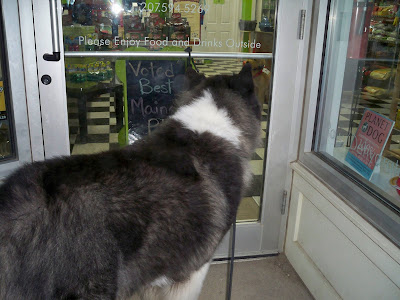
Since it was nice and cool out I decided to take Jack for a walk after his grooming session. He was NOT impressed that the Loyal Biscuit was closed. He even stood and whined at the door when I tried to walk by. I guess he doesnt mind his baths there if he still wants to visit! Maybe he knows I ordered him a new collar and is trying to make a pick up. (I cant wait to show it off.)


They are also bringing in a new line of collars and leashes that I absolutely LOVE. (To be announced by them soon I am sure.) This of course means I will be spending even more money on my dogs wardrobe in the future. ~sigh~ I guess there are worse things I could be buying though. What do YOU spend to much money on for your dogs?
Read More..

Doggie Birthday Party with Trix!

Kiko and I did a tricks lesson at a doggie birthday party at a dog park yesterday.  Louis the Maltese turned 1 !  It was loads of fun, and surprisingly not too chaotic, with about 30 dogs off leash.  Hootie the Pug won the tricks contest with his awesome version of "Crawl".  It was a hard to choose a winner as all the dogs in the contest rocked!  We also did an agility obstacle coarse.

Louis showing everone how to do "targeting"

Dance Dance Dance!


Mini Agility Obstacle Course!


"Tunnel anyone?"


Read More..

Dog Behavior Problems Solved With Easy Training Techniques


Puppy training is effective for any household with a canine pet for a number of reasons. One, its quicker to have friends and family over without having the dog barking or jumping. Also, they can be more unlikely to eliminate furniture. Read these tips on how to train your dog so that you can live together peacefully.

Enforce every one of the commands you issue in your dog. Do no issue a command on a whim. Should you truly mean it, only provide a command for your dog. This can lead to being forced to repeat your commands. A highly-trained dog should only have to be told once to accomplish something.

If they could possibly pull off not obeying on occasion, dogs quickly learn if you undoubtedly expect them to answer your commands whenever or. Dont send false messages! Dont give your pet dog a command if you do not are prepared to follow-through and insure your dog obeys that command.

Build a bridge involving the dogs reaction to a command and the reward for fulfillment. By saying a bridge word such as "yes" or "good", you will reinforce the behavior is acceptable as well as the reward will follow. Keep by using this bridge word even though training is done being consistent along with your pet.

Your dogs behavior during walks should become habit through consistency. Teach your dog to pay attention to you and your physical clues regarding their behavior. In case you are demanding and leading the eye of your own dog, teaching these to walk with you should come naturally to them. It will be emulated through your pet if you are walking with purpose.

After each workout, spend a short while playing your dogs favorite game with him. Your puppy will be aware of its coming following the training sessions and will be excited when considering time for your daily session if you do this whenever. The greater excited he or she is, the better hell do.

When training your dog, maintain your goals and expectations to your dog reasonable. The same as whenever you try and learn something new, your puppy isnt likely to learn new tricks at the first try you teach them. Different breeds as well as different dogs within the same breed, can have different levels of receptivity towards training.

Ensure you are feeding your pet high-quality food. Behavior issues are often the consequence of poor diet. High-quality dog food has human-grade ingredients as well as an expiration date. Ensuring that your puppy eats a lot of protein and steer clear of giving him "junk" food from the table. A properly-fed dog is a happy, obedient dog.

Try toilet training your dog without there being any accidents. Learn how to read your dog and anticipate his needs. Some clues to watch for are pacing, snuffling and whining. Permit it to out if you notice your puppy achieving this! Head outdoors on the assigned potty spot without delay. Whenever your dog uses the restroom outside, reward her or him with lots of praise. Accomplish this consistently and he will invariably show you when he needs to go outside.

As a way to possess a great dog, you have to learn control and firmness. This does not mean you ought to continually admonish your pet dog. Balance firmness with fascination with best results. Maintaining a suitable balance makes sure that the partnership between you and your dog is strong.

In order to avoid your pet from chewing, you ought to apply a smelly substance on objects your dog will not be designed to chew. Buy some chew toys for the dog: And a few use chewing as a method of releasing stress a result of loneliness, some dogs chew because they are undergoing teething.

One tip to remember when training your dog is the fact it is essential to be sure that your dog has most of his needs fulfilled. Your pet dog will not likely respond well to praise or punishment and definately will be unable to give attention to learning skills, if he is not being well cared for. Be sure to feed him well, shelter him comfortably and hang out messing around with him.

To correctly train your dog, you should be consistent constantly. Never enable your dog to participate in such activities as pulling yourself on walks or jumping around people. Dont ever give into your pets really cute face. In doing so, your pet will end up confused and not determine what is wrong or right in that particular situation and definately will do what he/she wants.

Leaders should go first, and you will teach that in your dog. Should you walk through doors along with your dog rushes past you through the opening, this means there is no need control plus your dog believes he or she is leader. Blocking the door so he cant make it through first, or teaching him to stay or stay whilst you walk ahead, helps him understand he needs to follow and prevent your lead.

Get your dog accustomed to being touched everywhere by petting and touching all his parts of the body. Make sure to include the stomach, toes and feet within the mouth, ears, snout and also the tail. Desensitizing your dog to being touched everywhere, helps train him never to attack a visitor who touches him inside an area he or she is not employed to being touched.

Whether you have a puppy or possibly a dog that isnt well behaved, you will discover strategies to train your furry friend and make it easier to live with one. You can test training yourself, or enroll your puppy inside an obedience school. If youve got a dog you must train, keep in mind tips in the following paragraphs.
Read More..

How To Deal With Your Dog Jumping On Furniture

This is a common problem and the method of dealing with this behaviour is very similar to that of jumping and stealing food from the counters.

Three approaches are used:

Consistency
Your dog should never be allowed to jump on the furniture

Counter-conditioning

Create a spot for your spot near your furniture (couch), which can be a blanket or doggie bed.
Put his favourite toys or special treats at the spot
For the first two months, whenever you sit at your furniture, leash him to the spot to avoid him from wondering off
After two months, walk your dog (on leash) to the furniture.
When he does not jump up to the furniture, praise and reward him.
If he jumps up to the furniture, immediately say ‘No’ and pull him away from the furniture
Repeat this exercise several times a day.

Correction

By the fourth month, your dog should learn not to jump on the furniture
If he still persists in this behaviour, it’s time to apply the booby trap to correct the behaviour:


i. Put a motion-sensitive sound alarm near the furniture so that alarm will trigger and sound when your dog jumps onto the furniture

ii. Make sure the alarm does not sound when he is near the furniture; only when he jumps onto the furniture

iii. Bring your dog near to the furniture and leave the room immediately

iv. If he jumps onto the furniture, alarm will sound and you should return to the room immediately and say ‘No’ to him followed by pulling him on his leash away from the furniture

If your dog is not deterred by this booby trap, it’s time to put a Scat Mat on the furniture. This device will send out a very small electrical shock upon touching it. No dog will want to repeat this behaviour after experiencing such an unpleasant zap. Rest assured that the electrical shock experience is harmless to both human and animal.


And remember to praise your dog abundantly when he does the right thing!


To your success in dogtraining
Read More..

Playdate with Jack Fiesta Island


Jack strikes a nobel pose. 


Haha! Splashed ya!
 Splash does her imitation of a Golden Retriever. 
Read More..

How To Deal with Your Dogs Digging

When you come home to find holes all over your lawn, and you have a dog, there may be a correlation there. But dont bother trying to confront your dog after the fact. Punishment after the fact is widely known as the least effective and potentially most damaging form of dog training on earth. Even if you bring your dog to the spot, hold them by the scruff of the neck, and scold them while you direct their head deep into their handiwork, they wont have any idea what all the fuss is about.


Instead, take a deep breath, and complete your after work wind-down routine. Then, calmly return to the back yard to locate your dog, with the intention of asking a few questions about their habit of excavating your property.


Question One


If you are unable to locate your dog, AND the holes in your lawn are all found right along the bottom of your fence line, then you may not need to ask the first question, which is, "Are you trying to escape?" If your pet is not "fixed" (neutered or spayed), then they may be entertaining their roaming instinct. They will return, and they may even bring a whole family with them when they do.


Question Two


Another possibility is that your dog is digging to freedom in an attempt to find you. If your dog is near or even somewhere on your property when you return from a period of absence, they may in fact have separation anxiety issues, which youll have to treat directly. Once you do, the digging will be an afterthought.


Question Three


If your dog is there, your next question to ask is, "Are you getting too hot back here when Im away?" We all know that dogs pant when its hot. But they also like to burrow, especially when there is not a spot of shade in sight. So youll need to rule this out as motivating factor for your dogs digging, and make sure they have a place to stay cool.


Lastly, youll have to ask your dog, "Are you burying your stuff?" This is simply an old habit that stems from the fact that their ancestors often killed more than they could eat in a sitting. This habit may be tough to break, but try changing the range of treats you leave with your dog when away. For instance, a massive juicy bone may be a great treat for your dog when youre around, but might be something you dont leave with them when youre gone.


You may have to change the dogs access areas, or fence off an area that youd like to keep for the kids soccer pitch. You can also try setting up a dirt area or sandbox where digging is allowed and encouraged. Many dogs are wild about sand, and you can even attract them to the area by burying treats in the sandbox.
To your success in dog training
Read More..

How To Deal With A Nipping or Mouthing Problem

In dealing with the problem of a nipping or mouthing dog/puppy, it is important to remember that it is a dog’s natural behaviour to nip. Hence it is unrealistic to expect such behaviour will be corrected within a few training sessions or totally eliminated overnight. However with consistency, patient and practice, such behaviour can be corrected over time.

Ways to curb nipping behaviour in a dog/puppy:

Avoid rough games such as play-slapping, wrestling, tug-of-war, etc
Avoid vigorous petting, especially around the face. Always pet the dog gently and keeps the hand slow.
Avoid playing with the dog using your hands as he may treat your hands as his toys. Keep several toys and treats at hand for the dog to focus on.
Give plenty of exercise, such as fetching games, hide-and-seek, etc to burn off the energy in him; especially before any petting or interaction as a tired dog or puppy is not likely to nip.
What to do when your dog/puppy nips you:

Method 1

Freeze immediately.

After freezing, say ‘Off’ or ‘No’ in a sharp tone but not to yell or shout.
At this time, the dog will take his mouth away, back away and/or look at you. At this point, praise him gently and calmly.
If he resumes his nipping, walk away from him.
After several minutes have passed, approach and resume the activity with him as long as he does NOT nip again.
Remember: Never allow or continue any activity with a nipping dog/puppy no matter how small he is or whether the bite hurts.

Method 2

This method can be used when the dog does not stop his nipping when you freeze:

Spray an ‘anti-chewing’ spray in the dog’s mouth once. The spray has a bitter taste and the dog will normally dislike such taste.
Spray it on your hands, feet and clothes before interacting with the dog.
Method 3

Put the dog on a leash (use a chain-link leash if he tends to bite the leash) or head collar before interacting with him.
Say ‘No’ when he nips and gently tug the leash.
Hold the dog’s head away from your body until the dog calms down.
Slowly put our hands or feet back toward the dog’s mouth. NO fast movement.
Praise him gently when he only sniffs or nuzzles as this is appropriate greeting gestures of a dog.


And remember to praise your dog abundantly when he does the right thing!


You Can Do It!
To yout dog training success
Read More..

Heeling reward placement with dog trainer Forrest Micke

Hello, Students!

Here is the video of Forrest using some toys to help motivate proper heel position and lots(!!) of focus on the handler. This will show you the use of the magnet ball as a training device. If you decide you want one, please let me know and Ill get you one when I place my order. E-mail me and Ill let you know what I find in the way of the best price--figure around $40.00, but Im not positive.


Read More..

Please help with my research!

Please help with my research by participating:

Click this link ---> Dog Survey!

Thanks! :)


Read More..

How To Deal With A Jumping Problem

Do you accept jumping from your dog when you play with him yet you do not allow such behaviour from him when you are all dressed up for work?

In this scenario, we are actually confusing our dogs and may even cause anxiety in them.


Always remember that jumping is a natural behaviour for a dog. Hence it is impossible to eliminate or correct such behaviour within a short period of time.

In dealing with this problem, we have to be consistent in our message to our dog that such behaviour is unacceptable.

To deal with this problem, always remember:

Avoid rough games.
Have toys for playing fetch with him and treats at hand to re-direct the dog’s attention during games.
If need be, use a leash during game.
When he jumps, simply say ‘No’ and gently tugs the leash
Holds the dog’s face and body away from you until he calms down and stops jumping
Then allows him to approach you again
Praise him when he approaches you WITHOUT jumping
Avoid excitable greetings.
Always greet and interact with the dog calmly and gently.
Teach him to sit as a way of greeting. Remember to Praise and Reward him for greeting you in the correct way.
To correct the dog’s jumping behaviour, combine both positive re-enforcement (praise and reward) and negative re-enforcement by letting him experience negative consequences (punishment) for jumping:

Method 1 – Losing his playmate

When he jumps, turn away and immediately stop all interaction with him
Do not touch him with your hand or look down at him as he may think that his jumping behaviour as acceptable
When he tries other methods such as sitting or fetching his toys to get your attention, praise him immediately and calmly so as not to excite and encourage the dog to jump.
If jumping does NOT stop at this time, walk away from him, which may mean leaving the room and not allowing the dog to follow you.
After two to three minutes, return to the room. Your dog should greet you in a calmer manner.
Method 2 – Using Physical Correction

Say ‘No’ immediately when the dog jumps.
Gently tugs the leash on the dog in a downward motion; or
Squirting the dog with water though some dogs love such action
Sit the dog and praise him for doing so
To train your dog to properly greet your guests at the front door:

Keep a spare leash or collar by the front door
When a guest arrives, immediately put the dog on leash
Put the dog in a sit-and-stay position by the front door
Invite the guest in
If the dog jumps on guest, say ‘No’, gently tug the leash to pull him off the guest, put him in his sit position again and praise him
Remember to have plenty of daily practices at the front door with the dog when there are no visitors. Open and close the door often enough for your dog to get used to the action. Then proceed to knocking at the front door and ringing the bell while keeping your dog in a sit-stay position all the while.

Such practices will help the dog to reduce his jumping, lessen his excitement and excessive barking at the front door.


And remember to praise your dog abundantly when he does the right thing!


You Can Do It!
To your success in dog training
Read More..

Food Stuffing Type Dog Toys What the heck do I do with this thing

You may have purchased one of those great interactive food stuffing toys for your dog, right? Maybe one of those red cone-shaped ones from the Kong Company? And you put some of your dogs kibble with a little peanut butter in it, gave it to him or her, and left it at that. But what now? What else can you do with it? OMG theres just SO much! As a matter of fact, I teach an entire class on stuffing food toys, and other types of "enrichment" at my inquisitive canine studio. 

I love feeding my own dog Poncho out of these, and other "interactive" food toys. He enjoys eating his meals out of them as well - I can tell because he goes into his "whirling dervish" mode every time I get one out of the freezer...yes, the freezer - hes at what I call "University Level". Pre-school would be dry kibble topped off with a little wet food. 

The Kong Company is nice enough to supply you with lots of tips and advice on great ways to use your dogs Kong toys. For me, I like coming up with my own "recipes" (okay, I think of them more of concoctions) with anything and everything that is either leftover from me and my hubby, or whatever I find in the fridge that needs to be eaten. 

Because the Kongs are relatively small on the inside, you arent able to put an entire meal in just one. So, like we humans have sets of dishes, I have purchased a few Kongs of the same size and consider them Ponchos "dishes". I might just give him one, along with his other favorite food toy the Tricky Treat Ball. And of course he gets his veggies in his bowl - there are some veggies in his Kong mixture, but most of them end up in his bowl...I think the veggies are the only thing Ill feed him from his bowl. 

Okay, so what all do I put in it? And how do I do it? Simple...for the easiest "recipe" I combine the following ingredients*:
  • Kibble (high quality like Solid Gold or Wellness)
  • Canned wet food (high quality like Solid Gold or Wellness)
  • Leftover veggies: canned pumpkin, zucchini, asparagus, bell peppers, carrots, peas, broccoli, cauliflower, summer squash etc...and anything else that might be around that he likes.
  • Fruit: apples, pears, berries (or whatever is around that he likes)
  • Grains: leftover brown rice, whole wheat pasta, couscous, quinoa, sweet and regular potatoes...and anything else leftover that he likes. 
  • Meat: scraps of whatever we have leftover
  • Dairy: plain non-fat yoghurt
I mix it all together, making sure there is enough kibble (which has many of Ponchos doggy specific required nutrients) and wet stuff to make it the consistency of a human type chicken salad. I add a little chicken broth or water to thin it out a bit. Then, I cover and refrigerate it overnight. This way, the kibble soaks up the water from the veggies etc...makes it a little stiffer, for easier stuffing. 

Now Im ready to prepare Ponchos meals. I take one of his Kong toys, and using a small fork or spoon, I fill it tightly with his "casserole". I then wrap it in plastic wrap, and put it in the freezer. This way, I can make a whole bunch of them, and keep them for when I need them. When theyre frozen, it takes him longer to go through one...instead of gulping down a meal in 10 seconds!

If youre just starting out, youll want to have your dog go through all the "stages" - beginners level (pre-school) to "University". If you start with a more difficult level, your dog might get frustrated and not want anything to do with it. Making it easy gets him or her conditioned to loving their Kong. They begin to associate the toy with more excitement than just the food itself. Its a fun game for them - plus again, this action taps into their predatory drive, and gives them something to do! 

Here are some "level of difficulty" suggestions, which are based upon how quickly your dog can get the food out:
  1. Beginner: dry kibble (can add in some dry treats to make it extra tasty and enticing), top off hole with wet food.
  2. Intermediate I: mix kibble with a little wet food, add any leftovers you want, loosely pack it - you still want to make it easy for food to come out. 
  3. Intermediate II: kibble, wet food, any leftovers you want to add, pack it tight. 
  4. Advanced: Freeze it! Initially you can thaw it partially before giving it to your dog, so as not to make it too difficult. 
Remember: there are some foods that are not healthy or safe for your dog - check with your vet if you are unsure. If youre dog has never had a Kong, its best to supervise until you know he or she know how to "use it". 
Read More..

An interview with

This blog is also what I use for my training business website. I forget that sometimes. I write about dogs because I am obsessed with my own dogs and I do alot with dogs. And I like to share info with everyone, not just potential clients. Besides my info is all there in the sidebar for anyone looking. I admit Im not the best at self selling. I give a lot of advicee away and dont do much in the way of marketing. I am working on getting my logo re-vamped however because I want to have some t-shirts to celebrate my 10 year anniversary coming up.

I was reading my APDT Chronicle recently and had this idea. Every month they profile a different member trainer to spotlight them. So I thought that I might do the same thing with their interview questions to post a little bit of info about me. Hopefully this isnt to cheesy. I will keep it simple and use the questions they used this month:

What services do you provide? I offer private in home training and behavior counseling. I also do phone consults for some of the rescue groups I am involved with.

How did you get started? The kennel club I was a member of needed to find a trainer to teach their group classes. I knew I didnt know quite enough to teach other peoples dogs so I found a trainer to apprentice with. It was a year long hands on course of work. I was fortunate in that I found a trainer who was one of the first of his kind (traditional trainers) to work with Dr. Ian Dunbar in this country. I came from a purely traditional background so positive training was new for me. While I learned how to properly use traditional methods (timing is everything in order to be fair to the dog) we worked mainly with the positive lure reward methods. I will always be grateful for that fabulous start in my training journey.

Are you involved with any dog sports or activities? I do AKC tracking for fun mostly with my pug. I think about trying for a title on occasion but havent put in the time to be really serious about it. I have shown a couple times in traditional obedience with our frenchie but got bitten by the Rally O bug more recently. I find it much more relaxed, realistic and fun for me. I also have a new interest in Treibball that I plan on pursuing.

How do you get your business, and what is your relationship like with the veterinarians in your community? Well I currently work for 1 vet full time so I have a great relationship with them! LOL Most of the area vets know me pretty well since I have worked for 2 others in the past and am very involved with my local shelter. I get lots of great referrals from them. Most of my business is word of mouth or they see me on the local cable access channel. I appear on occasion answering training and behavior questions on the humane societies show "Reigning Cats and Dogs".

Do you belong to a networking group, or otherwise consult with/refer to trainers in your area? Yes to both. I actually started a group on facebook for dog trainers of ALL methods as a way to share information in a positive setting. It is a group dedicated to promoting positive methods but in a way that isnt condescending or negative. I think trainers need to be able to share information and help educate others AND continue their own education. None of us knows everything after all. I have no problem referring to other trainers in the area. I dont offer group classes so I like to know where to best send those people looking for that service. I also know what sports other trainers teach and their methods. Because I specialize in serious behavior problems and do private training only I do not feel I am in direct competition with the other trainers. We are different in what we offer which I think is very helpful.

What is your communitys perspective in regard to positive training? I find most people who call are looking for a positive method trainer. I think we have the TV shows "Its me or the dog" with Victoria Stilwell and  "The Greatest American Dog" to thank for that. They really put the spotlight on the different methods and helped teach people that they do have a choice! Its not all choking and alpha rolls out there.

What do you believe are the three most important things to teach a dog? This is sort of a trick question because every dog needs different skills to live peacefully in its own home. A 100lb dog who jumps on people would need to learn "off" while the 5lb dog could get away with that for instance. But in general it would be: Leave it, wait (going out the door, jumping out of car, etc) and the recall.

What cases do you find most challenging? What techniques or philosophies have you found helpful in dealing with them? The cases where people feel at their wits end. They have tried everything and want me to come in and fix everything in one quick session. I find that simply teaching them how to communicate effectively with their dog, and how dogs learn, is a huge help. Once they understand that part of the lesson it is much smoother sailing.

What advice would you give other trainers about working with dogs and their owners? Be patient! We make things look easy because we have been doing it for years. We understand how timing works. The client needs time to learn it and practice it. And, never ask a client to do something with their dog you wouldnt do with/to your own dog.

Can you offer a specific tip or trick for working with dogs or owners? My favorite trick to show clients is to teach a dog how to ring a desk bell. I find this is the best way to show how marker training works. It is also a great thing to teach a dog of an owner who wants their dog to have a clear signal for potty time. Win/Win!

What was your scariest moment with a dog? It was a second session with an aggressive shepherd. For some reason the clients did not have the dog on a leash when I arrived (tho they usually did) and he grabbed my arm as I came in the door. Fortunately he released me quickly and did not break the skin. I always remember to remind clients of aggressive dogs to leash them before my arrival now.

What are the top three things you have learned as a trainer? Never be afraid to ask for help if you are stumped. Always admit if you dont have an answer and then get the answer for the client. You need to take time for yourself or you will burn out.

What was the last training-related seminar you have attended?  Self Control and Focus Games with Dee Ganley CPDT/CABC/CDBC 

Are there any specific books, authors, DVDs, or seminars that have influenced you as a trainer?  There are SO MANY great books and videos out there now! For books: "The other end of the leash" by Patricia McConnell Phd is a top fav. "The thinking dog" by Gail Fisher is a brilliant explanation of clicker training and has great historical info on traditional training. "How to teach a new dog old tricks" by Dr. Ian Dunbar is great. I love his lure reward training for deaf dogs too. "Aggression in dogs" By Brenda Aloff has alot of great info. For videos: I love "The power of marker training" by Leerburg. One of my favorite parts though is Ed Frawly admitting he was wrong about clicker training. "The language of dogs" by Sarah Kalnajs is a must have for anyone who works with dogs. Nowadays you also have websites and youtube videos that are excellent. My favorite website is http://www.dogstardaily.com/ and for youtube training videos none are better than the Kikopup channel.

I think everything you read and watch influences you as a trainer in some way. And I have been to some fabulous seminars over the years, all of which has helped me in my training journey. I say read as much as you can and watch as many training videos as you can and attend as many seminars as you can. I think it all helps when it comes to becoming a better trainer. No matter how many years someone has been working with dogs, there is always more to learn!!

Any other questions??
Read More..

Lost With Regards To Training Your Puppy Read These Guidelines!


Just like you must program your remote to manipulate your television, your puppy needs training to respond to your direction too. Such as a remote, someone must help it assist their TV, although working capabilities are there any. Though dogs offer an inner ability for training, someone must take it from them.

Small steps, gentle ways and patience are typical a part of having your puppy accustomed to their crate. Eventually they are going to become at ease with the crate and you can then attempt to shut the entrance on the crate. Whenever they enable the door to shut it is possible to give them a pleasure with the wiring. Start with leaving your pet inside the crate for roughly ten seconds, then increase that time by small increments. Should your puppy gets upset, then you may have to slow and possess more patience together.

Food and treats can be your ally in training your pet dog to get out his crate. Allow your dog to get strategically placed bits of food plus some treats every once in awhile when he returns to his crate. He will make it a practice of checking the crate out more regularly in the event something else has miraculously appeared there.

Usually do not tie up your dogs too closely. They could tangle the chains in a manner to ensure one or both of the dogs are stuck or injured. If one dog is larger than other, it may accidentally tangle the cord round the smaller dogs neck, causing it to be incapable of breath, as well as die.

While proper dog training with a leash, ensure that you are keeping the collar snug, yet a bit loose. Once the collar is simply too tight, it might can even make the dog want to pull you. A little bit slack can significantly help if you are proper dog training by using a leash.

Go on a class on training or study books and websites concerning the topic before you start to exercise your puppy. It appears to be very easy to train your dog but many things that will make sense to us wont appear sensible to some dog. Learning the proper way to train and studying the way to run a good training session will be helpful for the two of you in this process.

To instruct your pet anything, you need to be consistent. Which means you should give the same order whenever, and reward or punish your pet dog in the similar way, all the time. This helps your puppy assimilate certain concepts considerably faster than if you were using a more diverse and complex method of communicating.

To house train your pet dog, you ought to create a regular schedule for their meals. Eliminate their water during the night. You will be able to tell if it will need to go outside when your dog eats on schedule. Then you will not be able to bring it outside by the due date when you feed your pet dog right before going to bed.

To train a dog the best way to act around guests and other people at your residence, it is crucial that the dog is socialized with others. This experience of people, especially people who are new to your dog, will enable you to train the dog how he should react. This is helpful to the training process.

Monitor just how many treats accustomed to reward your pet dog each day for a healthy diet plan. Its super easy to overlook just how many treats you allow your dog, especially during a workout, however they accumulate when you dont give consideration.

Shy dogs make use of re-socializing. Oftentimes, dogs have behavioral incidents with certain situations, certain people or other dogs, who go unnoticed by us. We may not realize, however, these interactions have given our dogs a sour taste about these circumstances. Re-socializing your pet for the stimuli hes upset by, might help him overcome his anxiety.

Ensure you pay attention to your pet dog. What is he letting you know? Your dogs behavior will usually supply you with a window into his mind. Destructive dogs tend to be bored or anxious. Anxious dogs may act inconsistently with strangers. Regardless of the trouble, your puppy is letting you know how he feels as he behaves in situations.

If you are training your pet, its vital that you know that learning for dogs must be continuous, as it would be with humans. Dont cease working along with your dog when they master the commands you teach them. Cause them to work at additional skills, and this will subsequently perfect the initial skills they learn.

A barking dog can drive its owner and also the neighbors crazy! A good way to train your pet to never bark is always to offer him a reward to stop barking! As he barks, utilize a command like "Quiet! " or "No bark! " and wave his favorite treat looking at his nose. Soon he will learn that dog treats are better than making noise!

Your pet dog needs attention but you have to show him affection or play in a way that trains him to view you since the leader. It may be while he assumes he is your leader, whenever a dog tries to help you to pet him constantly or requires you to throw a ball for many hours. Ignoring his requests for constant attention, and ignoring the ball until you are ready, helps him to know who seems to be in control.

Hopefully you feel more competent to train your pet dog reading this post. Dogs want to make their owners happy, so training them is in fact enjoyable for them also.
Read More..

How Your Dog Will Communicate With You

Tags:

How Your Dog Will Communicate With You

October 5, 2009 by admin
Filed under Getting Ready to Train Your Dog
Leave a Comment
So many people speak about their dogs in terms of how they wish they were. If you had a dollar for every time you had heard or said the words “If only he/she could talk, the stories we would hear…” you’d probably be a very rich dog owner. But if dogs could talk, would they be so special to us? The chances are that we would still adore them every bit as much as we do, but the fact remains that much of what we get from owning a dog comes from the interaction that we have because they cannot speak. It just means that we find other ways to communicate.
Dogs can tell you a lot with a look. If they are hungry, they will make it clear by very patiently following you and looking pointedly at where they know their food to be kept. They will then thank you for feeding them by wagging their tail and affectionately nuzzling you – which may or may not be welcome at the time depending on the ratio of dog slobber to the price of your outfit. But, in many ways, the truth is that your dog will train you to some extent while you are training it.
Dogs may not be able to talk, but they communicate a lot with their eyes, their tail and their body language. And of course, they will bark. We learn to read these barks. A short, sharp bark will often signify excitement. A deep, low growl will warn of danger or threat. For many owners, the inquisitive yip is the best of all – the dog wants to learn from you, and trusts you to teach it.
Read More..

Dog Training With Good Courses

If you havent heard that dog is mans best mate. This is because a dog is looked at as being faithful, & loyal until its dying days, and probably you havent really doing dog training with good regular courses seriously. Canines make nice watchmen, when you require something watched, you. A dog is nice to be used as a person guard. People that have canines can usually point to an incident that their dog was their Saviour. One time a person gets a dog the first thing on their mind is usually dog training, this is because they require their dog to be the best it can be.

Dog training coursework
Theres lots of dog training coursework that can be found on the market. When choosing a dog training program you will require on that suits your needs. In most cases a dog training coursework will have the answer to a dog that will no listen at all. you can receive a coursework that will offer you a step by step guide as to how to train your dog, with is type of coursework its hard to fail. A coursework will teach your dog how to behave & be obedient.


Coursework that you can select from
There a few different coursework for canines out there. They will give you alot of different in depth knowledge, such as what type of food you ought to be feed your dog. The food a dog eats can be helpful for its behavior. For example when a human being has much sugar when they are young this will usually lead to hyper activity. A dog training courses will warn you to the companies that are selling dog food that is not the best for your dog. For the most part commercial dog food is known to not have all the right nutrients that the dog requires. Not have the right nutrients is like to mess together with your canines physical development.

It up to you to receive a dog training coursework that will have the desired effects for your dog. You know what you dog needs as you will be with him or her for the bulk of the day. You ought to receive a doge training coursework that deals with the canines diet, in alot of cases, a bad diet can lead to your dog being ferocious & unmanageable, even if you are doing consistent and great dog training with good regular courses.
Read More..

First 2 Weeks with a puppy


My new puppy is a terrier/chi mix. He is about 20 weeks old, 5 months. 

His pre existing issues were-
separation anxiety
house training
Timid with handling 

SO most of our training has been building the crate as a safe and wonderful place to be, as well as counter conditioning to me leaving the room while he is in the crate or loose.  
His initial behavior to being left alone for 10 minutes the second day that I had him was barking and howling and peeing and pooping in the crate and smearing it around on the crate walls with his paws.  Now after 2 weeks of tons of training, he settles and sleeps, and the other day I had to lure him out with a treat!  So I am very happy with how that is going!

The puppy hates grass, so I have also spend long hours standing in the yard patiently waiting.  The patience has paid off! :) 

Handling exercises 

What issues he didnt have but would be very important for  a new puppy in the first two weeks would be-
1- Restraint games
2- Reinforcing calmness rather than mouthing and biting 
3- Bite Inhibition

The first games we have been playing in these two weeks are-
1- default leave it from treats and bait bag while not working
2- positive interrupter/attention noise (I can call him away from playing with my other dogs already with the kissy noise)
3- Recalls
4- * Counter conditioning to handling!!!! * (the puppy was very hand shy)
5- Confidence on different surfaces using counter conditioning
6- How to follow a treat lure- (he would just pounce on my hand like it was prey rather than just follow it like a lure)
7- Crate games
8- Mat games
9- Settle
10- Loose leash walking
11- Touch with nose
12- Targeting with front paws
13- Building the tug and toys as secondary reinforcers
14- Basics of fetch

I constantly reinforce calmness and wonderful interactions with my other dogs, and interrupt him with the positive interrupter when play starts to get too aroused.  

So far so good!  

Read More..

Amazing Story Of A Blind Dog With Its Blind Owner

This is the Amazing Story Of A Blind Dog With Its Blind Owner.


Dogs are loyal friends of man and unquestioning loyalty. It is a blind man named Graham Waspe that all his activities, especially outside the house in Stowmarket, Suffolk, England, is highly dependent on Edward, his beloved dog who has become his guide in the last 6 years.


"Edward is a highly trained dog. He is my eyes and he could read my mind, "Graham was very fortunate to have Edward. "Feeling like he has a GPS device with automatic voice control; all he need is just say the market, Edward will take you to the market."
Amazing Story Of A Blind Dog With Its Blind Owner
But unfortunately their happy times together come to an end after the vets convicted of the cataracts that Edward have and they have to take his eyes.
Amazing Story Of A Blind Dog With Its Blind Owner
The End! Sad ending! End of story, both Graham and former guiding, Edward could only stay inside the house. Meanwhile, his wife Sandra could not take her out every time.


However this did not last long, the new guide has arrived.
Amazing Story Of A Blind Dog With Its Blind Owner
Graham has just received a new dog named Opal, younger and more agile of course. "Opal and I are getting closer. Hes as smart as Edward. I actually can not find any difference between them. "


Of his services to this family, Edward is allowed to stay together and follow the routines that were once done with Graham. Only, as the task of guiding been taken over by Opal, the lead dog his master who is blind as well as a blind dog.


This Amazing Story Of A Blind Dog With Its Blind Owner probably could be a great idea as a movie, right?
Read More..

Help During the Grieving Process With the Loss of a Beloved Pet

My friend Colleen Mihelich is an animal lover and pet loss expert who founded Peternity - a company dedicated to helping others celebrate the life and love of their furry friends. She also has the wonderful and informative Peternity blog, where she offers heartfelt stories, along with enlightening guidance on how to cope when you do lose a beloved pet. I know I dread the day, but I am comforted knowing she will be there for me if and when that day comes.

One of her latest posts was on Pet Loss Tips for Getting Through the Holidays. A few pet loss grieving tips she talked about were:
  • How to spend your time.
  • How to help others while helping yourself grieve.
  • How to honor your pet.
  • How to deal with your emotions.
After reading through the content, Id say one can use this information any time of the year - although, I know the holidays can be quite tough - especially since our non-human family members mean so much to us.

To read more about pet grieving tips from Colleen, please click here to see the Peternity blog post - You can also check out her Peternity website to share, heal, and help - both yourself and others.
Read More..